


Page 108 - Advanced Course
P. 108
KNX ADVANCED COURSE

                  Last but not least, it would have been impossible for KNX to establish the common
                  market infrastructure that exists today:

                      the fact that all products of all manufacturers can be linked to one working installation
                      is the corner stone of the KNX one configuration tool (ETS) approach.
                      It would have been impossible to establish the common training scheme for the
                      education of persons interested in using the KNX technology in home or commercial
                      projects. The training scheme of basic, advanced and tutor courses is worldwide
                      standardized. In contrast to that, manufacturers of proprietary systems must establish
                      each individually their own training schemes and users of such material must visit
                      several courses if they wish to combine material of several manufacturers into an
                      installation.


                  3  Principles of KNX Interworking


                  3.1  Introduction

                  For KNX devices that are programmed with the ETS, KNX requires that at least the group
                  objects are coded according to KNX standardized data types. The coding of parameters
                  that are described in the products’ database descriptions can be manufacturer specific.

                  For some of the device types (e.g. like dimming, blind control or switching with priority), it
                  is however necessary that actuators show a certain behaviour when data is sent to the
                  available group objects. In this case, the specification of functional blocks becomes
                  necessary and needs to be complied with during KNX product certification.

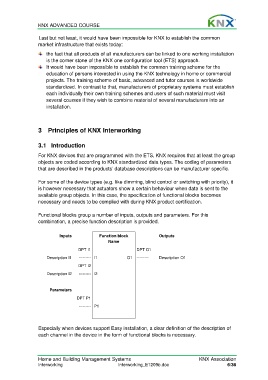
                  Functional blocks group a number of inputs, outputs and parameters. For this
                  combination, a precise function description is provided.

                           Inputs            Function block             Outputs
                                                 Name
                                    DPT I1                    DPT O1

                      Description I1   ---------  I1      O1  ---------   Description O1
                                    DPT I2
                      Description I2   ---------  I2


                       Parameters
                                   DPT P1
                                    ---------  P1


                  Especially when devices support Easy installation, a clear definition of the description of
                  each channel in the device in the form of functional blocks is necessary.


                  Home and Building Management Systems                                   KNX Association
                  Interworking                        Interworking_E1209b.doc                         6/36

