


Page 109 - Advanced Course
P. 109
KNX ADVANCED COURSE

                  3.2  Coding of Datapoint types


                  3.2.1  Introduction


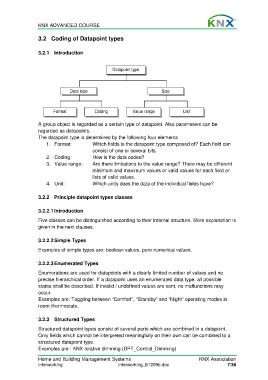
                                                   Datapoint type


                                Data type                                Size


                         Format            Coding           Value range           Unit

                  A group object is regarded as a certain type of datapoint. Also parameters can be
                  regarded as datapoints.
                  The datapoint type is determined by the following four elements
                      1.  Format:         Which fields is the datapoint type composed of? Each field can
                                          consist of one or several bits.
                      2.  Coding:         How is the data coded?
                      3.  Value range:    Are there limitations to the value range? There may be different
                                          minimum and maximum values or valid values for each field or
                                          lists of valid values.
                      4.  Unit:           Which units does the data of the individual fields have?


                  3.2.2  Principle datapoint types classes

                  3.2.2.1 Introduction

                  Five classes can be distinguished according to their internal structure. More explanation is
                  given in the next clauses.


                  3.2.2.2 Simple Types
                  Examples of simple types are: boolean values, pure numerical values.


                  3.2.2.3 Enumerated Types

                  Enumerations are used for datapoints with a clearly limited number of values and no
                  precise hierarchical order. If a datapoint uses an enumerated data type, all possible
                  states shall be described. If invalid / undefined values are sent, no malfunctions may
                  occur.
                  Examples are: Toggling between “Comfort”, “Standby” and “Night” operating modes in
                  room thermostats.


                  3.2.3  Structured Types
                  Structured datapoint types consist of several parts which are combined in a datapoint.
                  Only fields which cannot be interpreted meaningfully on their own can be combined to a
                  structured datapoint type.
                  Examples are : KNX relative dimming (DPT_Control_Dimming)
                  Home and Building Management Systems                                   KNX Association
                  Interworking                        Interworking_E1209b.doc                         7/36

