


Page 132 - Advanced Course
P. 132
KNX ADVANCED COURSE


                  4.18 Character String


                  4.18.1 General

                  To transfer strings of characters, datapoint types 16.000 and 16.001 allow sending text of
                  up to 14 characters. The coding of the individual characters corresponds to the datapoint
                  types 4.001 and 4.002. The contents in both cases starts with the MSB.
                  Two data types exist: DPT 16.001 (DPT_String_ASCII – unused characters are set to
                  value 00h) and DPT 16.002 (DPT_String_8859_1).


                  4.18.2 Example

                  “KNX is OK” is transmitted as:
                        K   N    X         i   S        O    K
                       4B   4E   58   20   69   73   20   4F   4B   00   00   00   00   00


                  4.19 Scene Control


                  4.19.1 General

                  In KNX three different approaches exist for setting scenes
                      Setting the scene conditions via ETS parameters and calling the desired
                      parameterized scene by using the DPT_Scene_AB (1.022) 1 bit datapoint type. In this
                      case, it is not possible that the user changes the scene.
                      Setting the scene conditions of the connected actuators and storing this scene as a
                      scene number in the connected actuators by using the DPT_Scene_Control. With the
                      same DPT, scenes can thus be set and called.
                      By using the DPT_SceneNumber: this DPT is identical to the DPT_Scene_Control,
                      however it does not allow to store new scenes.


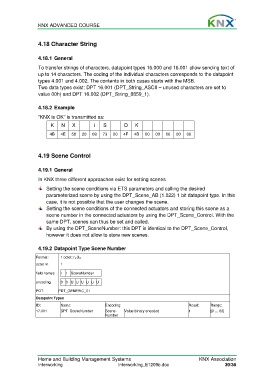
                  4.19.2 Datapoint Type Scene Number
                 Format:     1 octet: r 2U 6
                 octet nr.     1

                 field names    r  r  SceneNumber
                   encoding
                             0  0  U  U  U  U  U  U


                   PDT:
                           PDT_GENERIC_01
                 Datapoint Types
                 ID:        Name:               Encoding:                            Resol:    Range:
                 17.001     DPT_SceneNumber     Scene-  Value binary encoded         1         [0 … 63]
                                                Number


                  Home and Building Management Systems                                   KNX Association
                  Interworking                        Interworking_E1209b.doc                        30/36

