


Page 10 - Digital Electronics by harish
P. 10
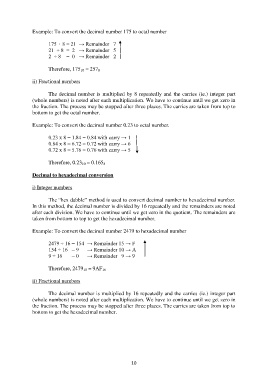
Example: To convert the decimal number 175 to octal number

                       175 † 8 = 21  → Remainder  7
                       21  † 8  =  2   → Remainder  5
                       2  † 8    =  0   → Remainder  2


                       Therefore, 175 10 = 257 8

               ii) Fractional numbers

                       The decimal number is  multiplied by 8 repeatedly and the carries  (ie.) integer part
               (whole numbers) is noted after each multiplication. We have to continue until we get zero in
               the fraction. The process may be stopped after three places. The carries are taken from top to
               bottom to get the octal number.

               Example: To convert the decimal number 0.23 to octal number.

                       0.23 x 8 = 1.84 = 0.84 with carry → 1
                       0.84 x 8 = 6.72 = 0.72 with carry → 6
                       0.72 x 8 = 5.76 = 0.76 with carry → 5


                       Therefore, 0.23 10 = 0.165 8

               Decimal to hexadecimal conversion

               i) Integer numbers

                       The “hex dabble” method is used to convert decimal number to hexadecimal number.
               In this method, the decimal number is divided by 16 repeatedly and the remainders are noted
               after each division. We have to continue until we get zero in the quotient. The remainders are
               taken from bottom to top to get the hexadecimal number.

               Example: To convert the decimal number 2479 to hexadecimal number

                       2479 † 16 = 154  → Remainder 15 → F
                       154 † 16   = 9      → Remainder 10 → A
                       9 † 16       = 0      → Remainder   9 → 9

                       Therefore, 2479 10 = 9AF 16

               ii) Fractional numbers

                       The decimal number is multiplied by 16 repeatedly and the carries (ie.) integer part
               (whole numbers) is noted after each multiplication. We have to continue until we get zero in
               the fraction. The process may be stopped after three places. The carries are taken from top to
               bottom to get the hexadecimal number.


                                                           10

