


Page 11 - Digital Electronics by harish
P. 11
Example: To convert the decimal number 0.23 to hexadecimal number.

                       0.23 x 16 = 3.68   = 0.68 with carry → 3   → 3
                       0.68 x 16 = 10.88 = 0.88 with carry → 10 → A
                       0.88 x 16 = 14.08 = 0.08 with carry → 14 → E

                       Therefore, 0.23 10 = 0.3AE 16

               Binary to decimal conversion

               i) Integer numbers

               The  given  binary  number  can  be  converted  to  decimal  number  by  using  the  following
               procedure:

               Step 1 : Write the binary number
               Step 2 : Write the place value (weight) directly under the binary number
               Step 3 : If the binary digit is zero, cross out the decimal weight
               Step 4 : Add the remaining weights to get the decimal number.

               Example: To convert the binary number 1011 to decimal number

                       Step 1 : 1  0  1  1 (Binary number)
                       Step 2 : 8  4  2  1 (Place value)
                       Step 3 : 8  4  2  1 (Cross out)
                       Step 4 : 11           (Add, to get the decimal number)

                       Therefore, 1011 2 = 11 10

               ii) Fractional numbers

               The same procedure used for the integer numbers can be used for fractional numbers also.

               Example: To convert the binary number 0.101 to decimal number

                       Step 1 :  1         0           1     (Binary number)
                       Step 2 : 0.5    0.25    0.125   (Place value)
                       Step 3 : 0.5   0.25     0.125   (Cross out)
                       Step 4 : 0.625                       (Add, to get the Decimal number)

                       Therefore, 0.101 2 = 0.625 10

               Binary to octal conversion

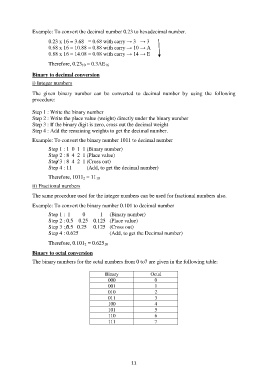
               The binary numbers for the octal numbers from 0 to7 are given in the following table:

                                                Binary              Octal
                                                 000                  0
                                                 001                  1
                                                 010                  2
                                                 011                  3
                                                 100                  4
                                                 101                  5
                                                 110                  6
                                                 111                  7


                                                           11

