


Page 18 - Digital Electronics by harish
P. 18
1.2     BOOLEAN ALGEBRA AND DE-MORGAN’S THEOREMS


               1.2.1  Boolean Algebra

                                     th
               In the middle of the 19  century, an English mathematician George Boole developed rules for
               manipulations of binary variables, known as Boolean algebra. This is the basis for all digital
               systems  like  computers,  calculators,  etc.  Binary  variables  can  be  represented  by  a  letter
               symbol such as A, B, X, Y, etc. The variable can have only one of the two possible values at
               any time either 0 or 1. The following are the operators used in Boolean algebra.

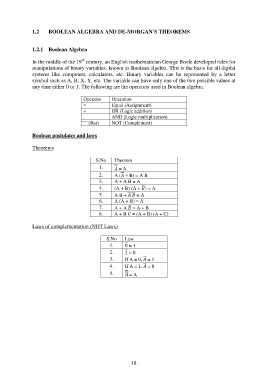
                                      Operator     Operation
                                      =            Equal (Assignment)
                                      +            OR (Logic addition)
                                      .            AND (Logic multiplication)
                                          (Bar)    NOT (Complement)

               Boolean postulates and laws

               Theorems

                                            S.No    Theorem
                                             1.      = A
                                             2.     A ( + B) = A B
                                             3.     A + A B = A
                                             4.     (A + B) (A + ) = A
                                             5.     A B +   = A
                                             6.     A (A + B) = A
                                             7.     A + A  = A + B
                                             8.     A + B C = (A + B) (A + C)

               Laws of complementation (NOT Laws)

                                                S.No     Law
                                                  1.     0 = 1
                                                  2.     1 = 0
                                                  3.     If A = 0,  = 1
                                                  4.     If A = 1,  = 0
                                                  5.      = A


                                                           18

