


Page 16 - Digital Electronics by harish
P. 16
1.1.3   Binary codes
               We use the decimal code to represent numbers. Digital electronic circuits in computers and
               calculators use mostly the binary code to represent numbers. Many other special codes are
               used in digital electronics to represent numbers, letters, and punctuation marks and control
               characters. These special codes are generally called binary codes. Some of the special binary
               codes are BCD code, Gray code, and Excess 3 code.

               BCD Code (Natural BCD code)

               BCD is an abbreviation for Binary-Coded Decimal. In this code, decimal digits 0 through 9
               are  represented  by  their  binary  equivalents  using  4  bits  (binary  digits)  individually.  For
               example, the decimal number 429 is expressed in BCD as follows:

                       Decimal number :     4         2        9
                       BCD number      :   0100   0010  1001

               The lowest BCD digit is 0000 and the highest BCD digit is 1001. In general, BCD codes are
               also  called  8421  code.  The  main  advantage  of  8421  code  is  that  converting  to  and  from
               decimal numbers is very easy.

               Excess-3 Code

               This is another form of BCD code. The code for each decimal digit is obtained by adding
               decimal number 3 to the natural BCD code. For example, decimal number 2 is coded as 0010
               + 0011 = 0101 in Excess-3 code. It is a self-complementing code which is very much useful
               in performing subtraction operation in digital systems. The Excess-3 codes for the decimal
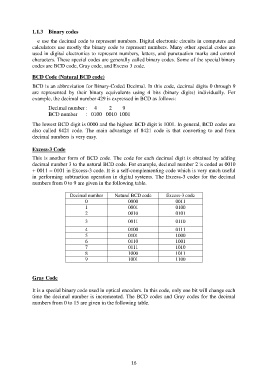
               numbers from 0 to 9 are given in the following table.

                                Decimal number      Natural BCD code       Excess-3 code
                                       0                  0000                 0011
                                       1                  0001                 0100
                                       2                  0010                 0101
                                       3                  0011                 0110

                                       4                  0100                 0111
                                       5                  0101                 1000
                                       6                  0110                 1001
                                       7                  0111                 1010
                                       8                  1000                 1011
                                       9                  1001                 1100


               Gray Code

               It is a special binary code used in optical encoders. In this code, only one bit will change each
               time the decimal number is incremented. The BCD codes and Gray codes for the decimal
               numbers from 0 to 15 are given in the following table.


                                                           16

