


Page 131 - SU Catalog 2017_18
P. 131
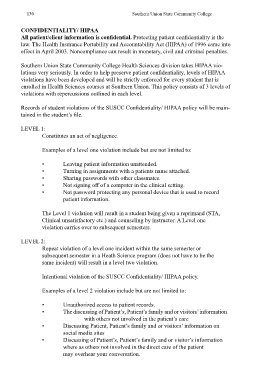
130                                 Southern Union State Community College            Southern Union State Community College                           131
                                                                                                      •      Sharing/Discussing the identity of a Patient, Patient’s family and or
        CONFIDENTIALITY/ HIPAA                                                                               visitors outside of the clinical setting, even if not discussing
        All patient/client information is confidential. Protecting patient confidentiality is the            information regarding their care.
        law. The Health Insurance Portability and Accountability Act (HIPAA) of 1996 came into
        effect in April 2003. Noncompliance can result in monetary, civil and criminal penalties.      The level 2 violation will result in the student receiving a clinical failure for
                                                                                                      the course that the offense took part in. Additionally the student will be
        Southern Union State Community College Health Sciences division takes HIPAA vio-              academically withdrawn from all health sciences courses. The student will have
        lations very seriously. In order to help preserve patient confidentiality, levels of HIPAA      to go through the application process for possible re-admission to the program.
        violations have been developed and will be strictly enforced for every student that is        This offense will stay in the student’s permanent file. If readmitted to a health
        enrolled in Health Sciences courses at Southern Union. This policy consists of 3 levels of      sciences program, any further violation of the SUSCC HIPAA policy will
        violations with repercussions outlined in each level.                                         automatically move the student to a Level 3 violation.

        Records of student violations of the SUSCC Confidentiality/ HIPAA policy will be main-  LEVEL 3:
        tained in the student’s file.                                                                 Additional violation of the SUSCC Confidentiality/ HIPAA policy after
                                                                                                      already receiving a Level 2 violation or a malicious offense used to cause harm
        LEVEL 1:                                                                                      to a person, or used for personal gain.
               Constitutes an act of negligence.
                                                                                                      The level 3 violation will result in student receiving a clinical failure for the
               Examples of a level one violation include but are not limited to:                      course that the offense took part in. Additionally the student will be
                                                                                                      academically withdrawn from all health sciences courses. The student will not
               •       Leaving patient information unattended.                                        have the option of returning to that program or any program of study in the
               •       Turning in assignments with a patients name attached.                          Health Sciences Division.
               •       Sharing passwords with other classmates.
               •       Not signing off of a computer in the clinical setting.                  The following are some general guidelines for students regarding HIPAA compliance
               •       Not password protecting any personal device that is used to record       •     Students should not discuss patient/client information with anyone except for
                       patient information.                                                           clinical personnel and those in the Health Science program who are involved in
                                                                                                      your education and adhere to the same confidentiality (e.g., faculty, graduate
               The Level 1 violation will result in a student being given a reprimand (STA,           colleagues).
               Clinical unsatisfactory etc.) and counseling by instructor. A Level one         •      Client records should never leave the clinical agency.
               violation carries over to subsequent semesters.                                 •      Students should never save patient/client sensitive information (with identifying
                                                                                                      information) on their computers.
        LEVEL 2:                                                                               •      E-mail correspondence with faculty should also be treated confidentially and
               Repeat violation of a level one incident within the same semester or                   identifying information about patients/clients should not be included.
               subsequent semester in a Heath Science program (does not have to be the         •      All documentation related to clinical clients must be treated as a legal document
               same incident) will result in a level two violation.                                   and confidentiality respected and maintained.
                                                                                               •      Client names should not be included in clinical paperwork, case presentations,
               Intentional violation of the SUSCC Confidentiality/ HIPAA policy.                      or on notes.
                                                                                               •      Photocopying of client records is NOT permitted in any clinical setting.
               Examples of a level 2 violation include but are not limited to:                 •      Records should not have client’s names or initials when turned in for clinical
                                                                                                      paperwork                                                          Division  Health Science
               •       Unauthorized access to patient records.                                 •      Students should NEVER discuss ANY information, no matter how insignificant
               •       The discussing of Patient’s, Patient’s family and or visitors’ information       it may seem, on any social media site.
                              with others not involved in the patient’s care                   •      All violations of the SUSCC confidentiality/ HIPAA will remain active for two
               •       Discussing Patient, Patient’s family and or visitors’ information on           years after the incident or until the completion of the currently enrolled program
                       social media sites                                                             (whichever is longer) regardless of the program. The active violation will
               •       Discussing of Patient’s, Patient’s family and or visitor’s information          transfer to any Health Science program from any other Health Science program
                       where as others not involved in the direct care of the patient
                       may overhear your conversation.                                         *Note: For more information regarding HIPAA,  visit http://www.hhs.gov/ocr/privacy/.

