


Page 10 - Michel Andreenko and Ukrainian Artists in Paris
P. 10
his wife Rikla, who was Jewish, in   New York in 1949. He became a U.S.
        their apartment from Nazi’s and    citizen and enrolled at the
        their sympathizers in Paris during
        the war, others like Wirsta, whose   Cooper Union School of Art where
        family left their western Ukrainian   he graduated in 1954. He spent
        home  in  Bukovina  for Romania,   the following year in Paris until
        kept moving from one location      1956, returning in 1958-59, taking
        to  another,  attempting  to  stay     a studio on Rue Vaugirard, where
                                                  he divided time working
                                                  there and New York.
                                                  Unlike  Hutsaliuk,  Wirsta
                                                  and    Solohub    made
                                                  Paris  their  final  home.
                                                  Both continued to study
                                                  art after they arrived
                                                  while also establishing
                                                  themselves economically,
                                                  a phenomenon common
                                                  to    refugees.  Wirsta
                                                  retold of his early days
                                                  of   painting   Parisian
                                                  landmarks    from   the
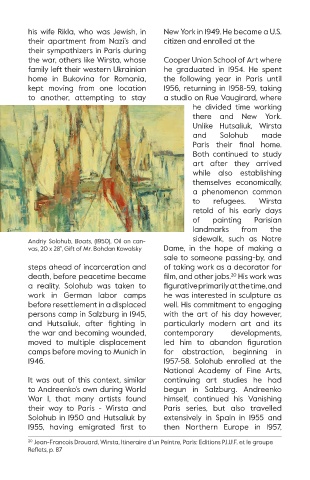
        Andriy Solohub, Boats, (1950), Oil on can-  sidewalk, such as Notre
          vas, 20 x 28”, Gift of Mr. Bohdan Kowalsky   Dame, in the hope of making a
                                           sale to someone passing-by, and
        steps ahead of incarceration and   of taking work as a decorator for
        death, before peacetime became     film, and other jobs.  His work was
                                                            20
        a reality. Solohub was taken to    figurative primarily at the time, and
        work in German labor camps         he was interested in sculpture as
        before resettlement in a displaced   well. His commitment to engaging
        persons camp in Salzburg in 1945,   with the art of his day however,
        and  Hutsaliuk,  after  fighting  in   particularly  modern  art  and  its
        the war and becoming wounded,      contemporary     developments,
        moved to multiple displacement     led  him  to  abandon  figuration
        camps before moving to Munich in   for abstraction, beginning in
        1946.                              1957-58. Solohub  enrolled  at  the
                                           National Academy of Fine Arts,
        It  was  out  of  this  context,  similar   continuing  art  studies  he  had
        to Andreenko’s own during World    begun in Salzburg. Andreenko
        War I, that many artists found     himself, continued his Vanishing
        their  way  to  Paris  -  Wirsta  and   Paris series, but also travelled
        Solohub in 1950 and Hutsaliuk by   extensively in Spain in 1955 and
        1955,  having  emigrated  first  to   then  Northern  Europe  in  1957,

        20  Jean-Francois Drouard, Wirsta, Itineraire d’un Peintre, Paris: Editions P.I.U.F. et le groupe
        Reflets, p. 87

