


Page 6 - Michel Andreenko and Ukrainian Artists in Paris
P. 6
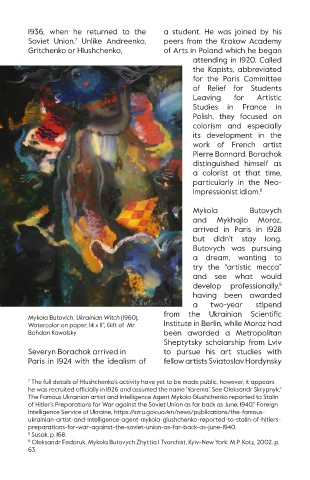
1936, when he returned to the      a student. He was joined by his
        Soviet Union.  Unlike Andreenko,   peers from the Krakow Academy
                    7
        Gritchenko or Hlushchenko,         of Arts in Poland which he began
                                                  attending  in 1920. Called
                                                  the Kapists, abbreviated
                                                  for the Paris Committee
                                                  of Relief for Students
                                                  Leaving    for   Artistic
                                                  Studies in France in
                                                  Polish, they focused on
                                                  colorism and especially
                                                  its development in the
                                                  work of  French artist
                                                  Pierre Bonnard. Borachok
                                                  distinguished himself as
                                                  a colorist at that time,
                                                  particularly in the Neo-
                                                  Impressionist idiom.
                                                                   8
                                                  Mykola         Butovych
                                                  and   Mykhajlo   Moroz,
                                                  arrived in Paris in 1928
                                                  but didn’t stay long.
                                                  Butovych was pursuing
                                                  a dream, wanting  to
                                                  try the  “artistic mecca”
                                                  and see  what  would
                                                  develop professionally,
                                                                        9
                                                  having been awarded
                                                  a    two-year   stipend
                                           from  the  Ukrainian  Scientific
        Mykola Butovich, Ukrainian Witch (1960),
        Watercolor on paper, 14 x 11”, Gift of  Mr.   Institute in Berlin, while Moroz had
        Bohdan Kowalsky                    been awarded a Metropolitan
                                           Sheptytsky scholarship from Lviv
        Severyn Borachok arrived in        to pursue his art studies with
        Paris in 1924 with the idealism of   fellow artists Sviatoslav Hordynsky

        7  The full details of Hlushchenko’s activity have yet to be made public, however, it appears
        he was recruited officially in 1926 and assumed the name ‘Yarema’. See Oleksandr Skrypnyk,“
        The Famous Ukrainian artist and Intelligence Agent Mykola Glushchenko reported to Stalin
        of Hitler’s Preparations for War against the Soviet Union as far back as June, 1940,” Foreign
        Intelligence Service of Ukraine, https://szru.gov.ua/en/news/publications/the-famous-
        ukrainian-artist-and-intelligence-agent-mykola-glushchenko-reported-to-stalin-of-hitlers-
        preparations-for-war-against-the-soviet-union-as-far-back-as-june-1940.
        8  Susak, p. 168.
        9   Oleksandr Fedoruk, Mykola Butovych Zhyttia I Tvorchist, Kyiv-New York: M.P. Kotz, 2002, p.
        63.

