


Page 4 - Michel Andreenko and Ukrainian Artists in Paris
P. 4
could live and rent studio space   Rooms to some tenants, as Vita
        in Montparnasse cheaply, albeit    Susak noted, resembled elongated
        many of low standard, without      coffins,  and  the  corridors  often
        running water or electricity. The   shared with mice and rats, with
        complex La Ruche [the Beehive]     roaming cats to catch them.
                                                                        3
        was one example. The brainchild    Alexander Archipenko, who lived
        of French sculptor Alfred Boucher   there for a year, from 1908 until
        (1850-1934), it was constructed of   1909, himself struggling for money,
        remaining structural elements      described it as “living inside a
                                           Gruyère cheese”.
                                                          4
                                           After World War I, the largest influx
                                           of artists came from the former
                                           Russian  Empire  and  Eastern
                                           Europe,   primarily   refugees,
                                           among the over 45,000 displaced
                                           by World War I.  Many were poor
                                                         5
                                           or impoverished, having lost
                                           belongings, income and family,
                                           and found the generosity of
                                           neighborhood café owners such as
                                           those at La Rotonde, comforting,
                                           where patrons could pay their
                                           bill with artwork, often displayed
                                           and then returned once monetary
                                           payment became available. It was
                                           into these general circumstances
                                           that Andreenko would have likely
                                           found himself when he arrived in
                                           December  of  1923.  His  extensive
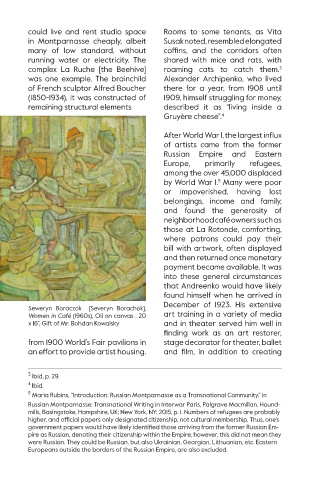
        Seweryn Boraczok  [Severyn Borachok],
        Women in Café (1960s), Oil on canvas , 20   art training in a variety of media
        x 16”, Gift of Mr. Bohdan Kowalsky   and in theater served him well in
                                           finding  work  as  an  art  restorer,
        from 1900 World’s Fair pavilions in   stage decorator for theater, ballet
        an effort to provide artist housing.   and  film,  in  addition  to  creating


        3  Ibid, p. 29.
        4  Ibid.
        5  Maria Rubins, “Introduction: Russian Montparnasse as a Transnational Community,” in
        Russian Montparnasse: Transnational Writing in Interwar Paris, Palgrave Macmillan, Hound-
        mills, Basingstoke, Hampshire, UK; New York, NY: 2015, p. 1. Numbers of refugees are probably
        higher, and official papers only designated citizenship, not cultural membership. Thus, one’s
        government papers would have likely identified those arriving from the former Russian Em-
        pire as Russian, denoting their citizenship within the Empire, however, this did not mean they
        were Russian. They could be Russian, but also Ukrainian, Georgian, Lithuanian, etc. Eastern
        Europeans outside the borders of the Russian Empire, are also excluded.

