


Page 165 - CarrLaneCatalog_2019ed-c.pdf
P. 165
SPRING PLUNGERS


            TECHNICAL INFORMATION


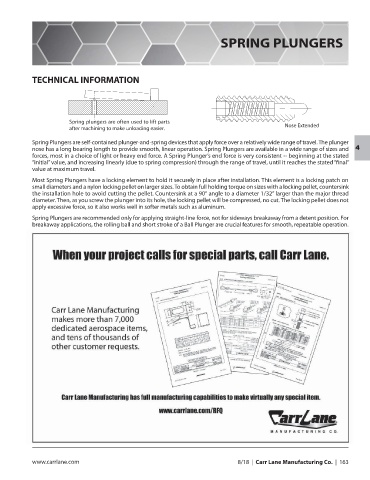
                        Spring plungers are often used to lift parts
                                                                                               Nose Extended
                        after machining to make unloading easier.
            Spring Plungers are self-contained plunger-and-spring devices that apply force over a relatively wide range of travel. The plunger
            nose has a long bearing length to provide smooth, linear operation. Spring Plungers are available in a wide range of sizes and  4
            forces, most in a choice of light or heavy end force. A Spring Plunger’s end force is very consistent -- beginning at the stated
            “initial” value, and increasing linearly (due to spring compression) through the range of travel, until it reaches the stated “final”
            value at maximum travel.

            Most Spring Plungers have a locking element to hold it securely in place after installation. This element is a locking patch on
            small diameters and a nylon locking pellet on larger sizes. To obtain full holding torque on sizes with a locking pellet, countersink
            the installation hole to avoid cutting the pellet. Countersink at a 90° angle to a diameter 1/32” larger than the major thread
            diameter. Then, as you screw the plunger into its hole, the locking pellet will be compressed, no cut. The locking pellet does not
            apply excessive force, so it also works well in softer metals such as aluminum.
            Spring Plungers are recommended only for applying straight-line force, not for sideways breakaway from a detent position. For
            breakaway applications, the rolling ball and short stroke of a Ball Plunger are crucial features for smooth, repeatable operation.


                Precision all in one shot.


            www.carrlane.com                                                   8/18  |  Carr Lane Manufacturing Co.  |  163

