


Page 548 - CarrLaneCatalog_2019ed-c.pdf
P. 548
BUSHING SELECTION


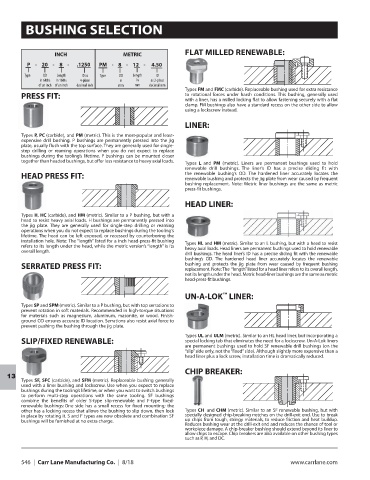
                   INCH                                      METRIC                                      FLAT MILLED RENEWABLE:
          P    -    20    -    8    -     .1250  PM    -    8    -    12    -     4.50
         Type  OD   Length  ID as  Type  OD  Length  ID
              in 64ths  in 16ths  4-place  in  in  as 2-place
              of an inch of an inch  decimal inch  mm  mm  decimal mm
                                                              Types FM and FMC (carbide). Replaceable bushing used for extra resistance
        PRESS FIT:                                            to rotational forces under harsh conditions. This bushing, generally used
                                                              with a liner, has a milled locking flat to allow fastening securely with a flat
                                                              clamp. FM bushings also have a standard recess on the other side to allow
                                                              using a lockscrew instead.

                                                              LINER:

        Types P, PC (carbide), and PM (metric). This is the most-popular and least-
        expensive drill bushing. P bushings are permanently pressed into the jig
        plate, usually flush with the top surface. They are generally used for single-
        step drilling or reaming operations when you do not expect to replace
        bushings during the tooling’s lifetime. P bushings can be mounted closer
        together than headed bushings, but offer less resistance to heavy axial loads.  Types  L  and  PM  (metric). Liners are permanent bushings used to hold
                                                              renewable drill bushings.  The liner’s ID has a precise sliding fit with
        HEAD PRESS FIT:                                       the renewable bushing’s OD.  The hardened liner accurately locates the
                                                              renewable bushing and protects the jig plate from wear caused by frequent
                                                              bushing replacement. Note: Metric liner bushings are the same as metric
                                                              press-fit bushings.
                                                              HEAD LINER:

        Types H, HC (carbide), and HM (metric). Similar to a P bushing, but with a
        head to resist heavy axial loads. H bushings are permanently pressed into
        the jig plate.  They are generally used for single-step drilling or reaming
        operations when you do not expect to replace bushings during the tooling’s
        lifetime. The head can be left exposed, or recessed by counterboring the
        installation hole. Note: The “length” listed for a inch head-press-fit bushing   Types HL and HM (metric). Similar to an L bushing, but with a head to resist
        refers to its length under the head, while the metric version’s “length” is its   heavy axial loads. Head liners are permanent bushings used to hold renewable
        overall length.
                                                              drill bushings. The head liner’s ID has a precise sliding fit with the renewable
                                                              bushing’s OD.  The hardened head liner accurately locates the renewable
        SERRATED PRESS FIT:                                   bushing and protects the jig plate from wear caused by frequent bushing
                                                              replacement. Note: The  “length” listed for a head liner refers to its overall length,
                                                              not its length under the head. Metric head-liner bushings are the same as metric
                                                              head-press-fit bushings.

                                                                           ™
                                                              UN-A-LOK  LINER:
        Types SP and SPM (metric). Similar to a P bushing, but with top serrations to
        prevent rotation in soft materials. Recommended in high-torque situations
        for materials such as magnesium, aluminum, masonite, or wood. Finish-
        ground OD ensures accurate ID location. Serrations also resist axial force to
        prevent pushing the bushing through the jig plate.
                                                              Types UL and ULM (metric). Similar to an HL head liner, but incorporating a
        SLIP/FIXED RENEWABLE:                                 special locking tab that eliminates the need for a lockscrew. Un-A-Lok liners
                                                              are permanent bushings used to hold SF renewable drill bushings (on the
                                                              “slip” side only, not the “fixed” side). Although slightly more expensive than a
                                                              head liner plus a lock screw, installation time is dramatically reduced.

                                                              CHIP BREAKER:
   13
        Types SF, SFC (carbide), and SFM (metric). Replaceable bushing generally
        used with a liner bushing and lockscrew. Use when you expect to replace
        bushings during the tooling’s lifetime, or when you want to switch bushings
        to perform multi-step operations with the same tooling. SF bushings
        combine the benefits of older S-type slip-renewable and F-type fixed-
        renewable bushings: One side has a small recess for fixed mounting; the
        other has a locking recess that allows the bushing to slip down, then lock   Types CH  and CHM (metric). Similar to an SF renewable bushing, but with
        in place by rotating it. S and F types are now obsolete and combination SF   specially designed chip-breaking notches on the drill-exit end. Use to break
        bushings will be furnished at no extra charge.        up chips from tough, stringy materials, to reduce friction and heat buildup.
                                                              Reduces bushing wear at the drill-exit end and reduces the chance of tool or
                                                              workpiece damage. A chip-breaker bushing should extend beyond its liner to
                                                              allow chips to escape. Chip breakers are also available on other bushing types
                                                              such as P, H, and DC.


        546  |  Carr Lane Manufacturing Co.  |  8/18                                             www.carrlane.com

