


Page 550 - CarrLaneCatalog_2019ed-c.pdf
P. 550
INSTALLATION AND TECHNICAL DATA


        RECOMMENDED CHIP CLEARANCE:                           SPECIAL BUSHINGS FOR CLOSE HOLE
                                                              SPACING:


                                         1/2 to 1-1/2 times
                                         drill dia


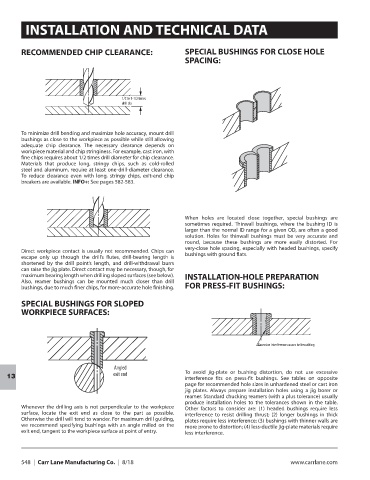
        To minimize drill bending and maximize hole accuracy, mount drill
        bushings as close to the workpiece as possible while still allowing
        adequate chip clearance.  The necessary clearance depends on
        workpiece material and chip stringiness. For example, cast iron, with
        fine chips requires about 1/2 times drill diameter for chip clearance.
        Materials that produce long, stringy chips, such as cold-rolled
        steel and aluminum, require at least one-drill-diameter clearance.
        To reduce clearance even with long, stringy chips, exit-end chip
        breakers are available. INFO+: See pages 582-583.


                                                              When holes are located close together, special bushings are
                                                              sometimes required. Thinwall bushings, where the bushing ID is
                                                              larger than the normal ID range for a given OD, are often a good
                                                              solution. Holes for thinwall bushings must be very accurate and
                                                              round, because these bushings are more easily distorted. For
                                                              very-close hole spacing, especially with headed bushings, specify
        Direct workpiece contact is usually not recommended. Chips can
        escape only up through the drill’s flutes, drill-bearing length is   bushings with ground flats.
        shortened by the drill point’s length, and drill-withdrawal burrs
        can raise the jig plate. Direct contact may be necessary, though, for
        maximum bearing length when drilling sloped surfaces (see below).   INSTALLATION-HOLE PREPARATION
        Also, reamer bushings can be mounted much closer than drill
        bushings, due to much finer chips, for more-accurate hole finishing.  FOR PRESS-FIT BUSHINGS:

        SPECIAL BUSHINGS FOR SLOPED
        WORKPIECE SURFACES:


                                                                                      Excessive interference causes bellmouthing


                                       Angled
                                      exit end                To avoid jig-plate or bushing distortion, do not use excessive
   13                                                         interference fits on press-fit bushings. See tables on opposite
                                                              page for recommended hole sizes in unhardened steel or cast iron
                                                              jig plates. Always prepare installation holes using a jig borer or
                                                              reamer. Standard chucking reamers (with a plus tolerance) usually
                                                              produce installation holes to the tolerances shown in the table.
        Whenever the drilling axis is not perpendicular to the workpiece   Other factors to consider are: (1) headed bushings require less
        surface, locate the exit end as close to the part as possible.   interference to resist drilling thrust; (2) longer bushings in thick
        Otherwise the drill will tend to wander. For maximum drill guiding,   plates require less interference; (3) bushings with thinner walls are
        we recommend specifying bushings with an angle milled on the   more prone to distortion; (4) less-ductile jig-plate materials require
        exit end, tangent to the workpiece surface at point of entry.  less interference.


        548  |  Carr Lane Manufacturing Co.  |  8/18                                             www.carrlane.com

