


Page 100 - History of The Quranic Text | Kalamullah.Com
P. 100
80            THE HISTORY OF THE QUR'ANIC TEXT

                                      one Q/ them should make a mistake, the other could remind her. And the
                                      witnesses mustnotrefuse [to give evidence) whenever thry are called upon. "10

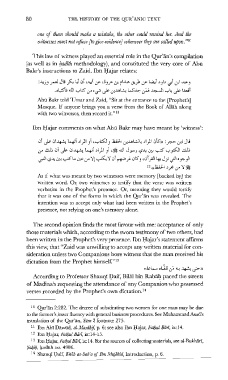
                                    This law of witness played an essential role in the Qur'an's compilation
                                  (as well as in badlth methodology), and constituted the very core of Abu
                                  Bakr's instructions to Zaid. Ibn Hajar relates:

                                      :-'ijJ ~ J\i ~ 4\ 0\ '0..,;\ ,f ,.Jf J. ,u.... J:.)o ,f 4\ .>Jb ~\ w-!\ ~J
                                            .•L,.:S1.; .wI yl::5"<J"''';- ~ Cr.!,u~ W"'.b,. ~ ~\ Y4 ~ l..wi
                                      Abu Bakr told 'Umar and Zaid, "Sit at the entrance to the [prophet's]
                                      Mosque. If anyone brings you a verse from the Book of Allah along
                                      with two witnesses, then record it." II

                                    Ibn Hajar comments on what Abu Bakr may have meant by 'witness':

                                      0\ ~ 01~ ~\ .>\)1 Ji ,yL;SJI ..t2kl1 Cr.!,uW4 .>1)\ 0l5'» :~ 0'1 J\i
                                                              J
                                      <J".!..U~ 0i ~ 01~ ~1 .>1)1 J\ ,~.wl JY") ,-?-'i 0;! ~ y p:J.1 .!..U~
                                      ~I ,-?-'i 0;! ~ I.A l.J':" <J" ~! ~ ~ 0i r+'".J- 0lS'J ,0T,;JI 4-! Jj .}I •Y'"}I
                                                                            12 «..t2kl\ .>fi <J" ~ ~
                                      As if what was meant by two witnesses were memory [backed by] the
                                      written word. Or, two witnesses to testify that the verse was written
                                      verbatim in the Prophet's presence. Or, meaning they would testify
                                      that it was one of the forms in which the Qur'an was revealed. The
                                      intention was to accept only what had been written in the Prophet's
                                      presence, not relying on one's memory alone.


                                    The second opinion finds the most favour with me: acceptance of only
                                  those materials which, according to the sworn testimony of two others, had
                                  been written in the Prophet's very presence. Ibn Hajar's statement affirms
                                  this view, that "Zaid was unwilling to accept any written material for con-
                                  sideration unless two Companions bore witness that the man received his
                                  dictation from the Prophet himself.v"
                                                                           «l>-L.....,. .Ut,;. "--! ~ ~»
                                    According to Professor ShauqI Daif Bilal bin Rabah paced the streets
                                  of Madinah requesting the attendance of any Companion who possessed
                                  verses recorded by the Prophet's own dictation."


                                    10 Qur'an 2:282. The decree of substitutingtwo women for one man may be due
                                  to the former'slesserfluencywith generalbusiness procedures.See Muhammad Asad's
                                  translation of the Qur'an, Sura 2 footnote 273.
                                    II Ibn Abi Dawud, al-McqiiJ;ij, p. 6; see also Ibn Hajar, Fathul Ban, ix:14.
                                    12 Ibn Hajar, Fathul Ban, ix: 14-15.
                                    13 Ibn Hajar, FathulBan, ix:14. Forthe sourcesof collecting materials,seeal-Bukhari,
                                  Sa1J0, hadith no. 4936.
                                    14 Shauqi pall, Kitab as-Sab'a if Ibn Mujiihid, Introduction, p. 6.

