


Page 101 - History of The Quranic Text | Kalamullah.Com
P. 101
THE WRITTEN COMPILATION OF THE QUR'AN           81

                                   iv. How Zaid bin Thabit Utilised the Written Materials

                            The normal procedure in collating manuscripts is for the editor to compare
                            different copies of the same work, though naturally not all copies will be of
                            equal value. In outlining manuscript gradations, which are most dependable
                            and which are worthless, Bergstrasser set out a few rules among the most
                            important of which are:
                              1. Older copies are generally more reliable than newer ones.
                              2. Copies that were revised and corrected by the scribe, through com-
                                  parison with the mother manuscript, are superior to those which
                                  lack this. 15
                              3. If the original is extant, any copy scribed from this loses all signif-
                                  icance.l''
                              Blachere and Sauvaget reiterate this third point: should the author's
                            original autograph exist, or a copy revised by the author, then the value
                            of all other copies is negated.'? Likewise, in the absence of the author's
                            original, any duplicate whose mother copy is available is discarded.

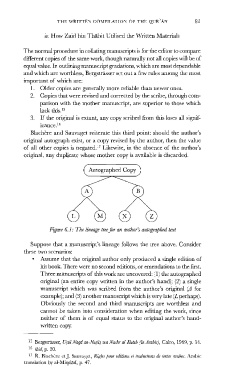
                                                  Autographed Copy


                                                 A


                                            L                 x        Z

                                     Figure 6.1: The lineage treefir an author's autographed text

                              Suppose that a manuscript's lineage follows the tree above. Consider
                            these two scenarios:
                                  Assume that the original author only produced a single edition of
                                  his book. There were no second editions, or emendations to the fIrst.
                                  Three manuscripts of this work are uncovered: (1)the autographed
                                  original (an entire copy written in the author's hand); (2) a single
                                  manuscript which was scribed from the author's original (A for
                                  example); and (3)another manuscript which isvery late (Lperhaps).
                                  Obviously the second and third manuscripts are worthless and
                                  cannot be taken into consideration when editing the work, since
                                  neither of them is of equal status to the original author's hand-
                                  written copy.

                              is Bergstrasser, Usid Naqdan-Nusii; waNashr al-Kutub (inArabic), Cairo, 1969, p. 14.
                              16 ibid, p. 20.
                              17 R. Blachere etJ. Sauvaget, Regles pour editions et traductions de textes arabes. Arabic
                            translation by al-Miqdad, p. 47.

