


Page 68 - History of The Quranic Text | Kalamullah.Com
P. 68
48            THE HISTORY OF THE QUR'ANIC TEXT

                                      j.,'" "'~.J  ,.. t  'l,.,.J  .."""  ...."7.J  .... .. ....  ..."" ....  1',.1 ...  ,.I  'l"... .J
                                     i}''ll ~..Jj I}I (!JJ~ rX J.-i~I~ Q~ -S;UI ~)~~ I}\,
                                                    28,{ 1>~ ~;J L. ~~~T ~,~...JijL ~ -siT ~'\
                                                     " ~dJ r-o;
                                                                                         \,,~
                                                                          \~..
                                                                u-- - ~
                                                                                      ..
                                                                                ,:
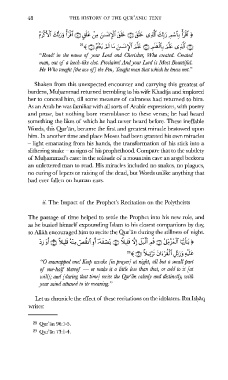
                                      "Read! in the name ifyour Lord and Cherisher, Who created. Created
                                      man, outif a leech-like clot. Proclaim! Andyour Lordis Most Bountiful.
                                      He Who taught [the use if} the Pen) Trzught manthatwhich heknewnot."
                                    Shaken from this unexpected encounter and carrying this greatest of
                                  burdens, Muhammad returned trembling to his wife Khadija and implored
                                  her to conceal him, till some measure of calmness had returned to him.
                                  As an Arab he was familiar with all sorts of Arabic expressions, with poetry
                                  and prose, but nothing bore resemblance to these verses; he had heard
                                  something the likes of which he had never heard before. These ineffable
                                  Words, this Qur'an, became the first and greatest miracle bestowed upon
                                  him. In another time and place Moses had been granted his own miracles
                                  - light emanating from his hands, the transformation of his stick into a
                                  slithering snake - as signs of his prophethood. Compare that to the subtlety
                                  of Muhammad's case: in the solitude of a mountain cave an angel beckons
                                  an unlettered man to read. His miracles included no snakes, no plagues,
                                  no curing of lepers or raising of the dead, but Words unlike anything that
                                  had ever fallen on human ears.


                                       ii. The Impact of the Prophet's Recitation on the Polytheists

                                  The passage of time helped to settle the Prophet into his new role, and
                                  as he busied himself expounding Islam to his closest companions by day,
                                  so Allah encouraged him to recite the Qur'an during the stillness of night.
                                         t  ~  ... j.  j..J t  J""  '"  P'....  ~.  ,....,~....  J  ._.  J  ...1J J. "'.... At ..
                                      ~ ; '.1 rnl '.>\..Jj ...:;... '.=1:.1 .1 ~~ :tTY '.>\..Jj '11  1 II ~ (QY ~ -. : \I I" lI.J ~
                                      -{...I  ""'~  -...  .. v  - --!  .. ~  ....  : ~  ...  ~,o;  ..~  ~  .. I
                                                                    29,{ f~) ~,; ~ 1~'~iT ,,"...:.t:.
                                                                     '" I..,p  .;/ \J .r: y-'..J-',.
                                      "0 enwrapped one! Keep awake [inprayer] at night) all but a smallpart
                                      if one-half thereof -  ormake it a little less than that) or add to it [at
                                      will]; and[during that time] recite the Qyriin calmly and distinctly, with
                                     your mindattuned toits meaning. "


                                    Let us chronicle the effect of these recitations on the idolaters. Ibn Ishaq
                                  writes:


                                   28 Qur'an 96:1-5.
                                   29 Qur'an 73:1-4.

