


Page 122 - Tafsir of surat at tawba repentance
P. 122
© Islamic Online University Usool at-Tafseer
8
_________________________
THE QUR’AANIC TEXT
Order of the Verses and Chapters
A of the Qur’aan is called an “aayah,” 1 which literally means a sign or
verse
token by which a person or thing is known, and a chapter is referred to as a
2
“soorah,” which literally means enclosure or wall. The order of the aayahs
in each soorah was set by the Prophet (r) himself, as is indicated in a number of
hadeeths (recorded sayings or actions of the Prophet [r]). For example, ‘Uthmaan
ibn Abee al-‘Aas said, “Once while I was sitting with Allaah’s Messenger (r), he
rolled his eyes upwards in a stare, then after a while he lowered them and said,
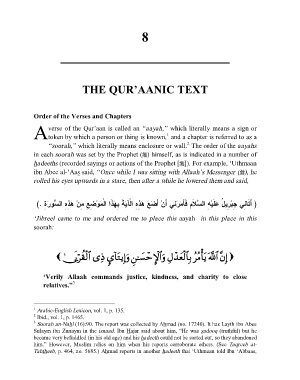
(. ِﺓﺭﻭﺴﻟﺍ ِﻩِﺫﻫ ﻥِﻤ ِﻊِﻀﻭﻤﹾﻟﺍ ﺍﹶﺫﻬِﺒ ﹶﺔﻴﺂﹾﻟﺍ ِﻩِﺫﻫ ﻊﻀَﺃ ﻥَﺃ ﻲِﻨﺭﻤَﺄﹶﻓ ﻡﹶﻼﺴﻟﺍ ِﻪﻴﹶﻠﻋ ُلﻴِﺭﺒِﺠ ﻲِﻨﺎﹶﺘَﺃ )
‘Jibreel came to me and ordered me to place this aayah in this place in this
soorah:
( 4n1öà)ø9$# Ï Ç!$tGÎ)ur Ç`»|¡ômM}$#ur ÉAôyèø9$$Î/ ããBù't ©!$# ¨bÎ) )
‘Verily Allaah commands justice, kindness, and charity to close
3
relatives.”
1
Arabic-English Lexicon, vol. 1, p. 135.
2
Ibid., vol. 1, p. 1465.
3
Soorah an-Nahl (16):90. The report was collected by Ahmad (no. 17240). It has Layth ibn Abee
Sulaym ibn Zunaym in the isnaad. Ibn Hajar said about him, “He was sadooq (truthful) but he
became very befuddled (in his old age) and his hadeeth could not be sorted out, so they abandoned
him.” However, Muslim relies on him when his reports corroborate others. (See Taqreeb at-
Tahtheeb, p. 464, no. 5685.) Ahmad reports in another hadeeth that ‘Uthmaan told Ibn ‘Abbaas,
http://www.islamiconlineuniversity.com 3

