


Page 126 - Tafsir of surat at tawba repentance
P. 126
© Islamic Online University Usool at-Tafseer
The Qur’aanic texts of ‘Uthmaan’s era were written without dashes (tashkeel,
i.e. fat-hah, kasrah and dammah) to indicate the vowels and without dots (nuqat)
to distinguish between look-alike letters (e.g. Seen and Sheen, Saad and Daad,
etc.) The verses were not numbered, nor were there any punctuation signs to
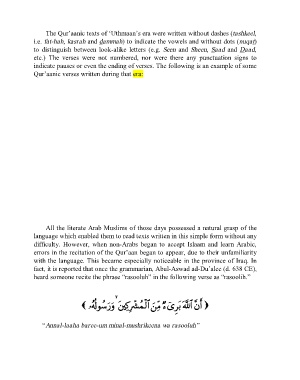
indicate pauses or even the ending of verses. The following is an example of some
Qur’aanic verses written during that era:
All the literate Arab Muslims of those days possessed a natural grasp of the
language which enabled them to read texts written in this simple form without any
difficulty. However, when non-Arabs began to accept Islaam and learn Arabic,
errors in the recitation of the Qur’aan began to appear, due to their unfamiliarity
with the language. This became especially noticeable in the province of Iraq. In
fact, it is reported that once the grammarian, Abul-Aswad ad-Du’alee (d. 638 CE),
heard someone recite the phrase “rasooluh” in the following verse as “rasoolih.”
( ¼ã&è!qßuur tûüÏ.Îô³ßJø9$# z`ÏiB ÖäüÌt/ ©!$# ¨br& )
“Annal-laaha baree-um minal-mushrikeena wa rasooluh”
http://www.islamiconlineuniversity.com 7

