


Page 132 - Tafsir of surat at tawba repentance
P. 132
© Islamic Online University Usool at-Tafseer
the following incident narrated by one of the Prophet’s closet companions. ‘Umar
ibn al-Khattaab said, “Once during the lifetime of Allaah’s Messenger (r), I
heard Hishaam ibn Hakeem reciting Soorah al-Furqaan in salaah, and I noticed
that he recited it differently from the way in which the Prophet (r) had taught me.
I was on the verge of jumping on him during his salaah, but I managed to control
my anger until he completed his prayer. Upon its completion, I grabbed him by
the neck of his cloak and said, ‘Who taught you this soorah that I heard you
reciting?’ He replied, ‘Allaah’s Messenger (r) taught it to me!’ I said, ‘You are a
liar, for Allaah’s Messenger (r) has taught it to me in a different way from the
way you recited it!’ I then dragged him to Allaah’s Messenger (r) and said to
him, ‘I heard this person reciting Soorah al-Furqaan in a different way from the
way that you taught me.’ Allaah’s Messenger (r) then said, ‘Release him ‘Umar!
Recite Hishaam!’ Hishaam recited in the same way that I heard him reciting
previously. Then the Messenger of Allaah (r) said, ‘It was revealed in this way!’
He then said, ‘Recite ‘Umar!’ When I completed reciting it the way he had taught
me, he said,
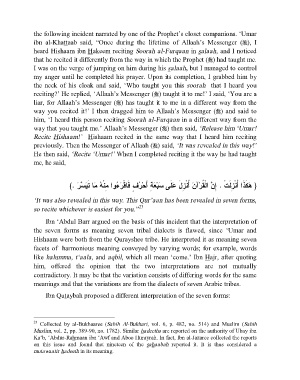
(. ﺭﺴﻴﹶﺘ ﺎﻤ ﻪﹾﻨِﻤ ﺍﻭﺀﺭﹾﻗﺎﹶﻓ ٍﻑﺭﺤَﺃ ِﺔﻌﺒﺴ ﻰﹶﻠﻋ َلِﺯﹾﻨُﺃ ﻥﺁﺭﹸﻘﹾﻟﺍ ﻥِﺇ . ﹾﺕﹶﻟِﺯﹾﻨُﺃ ﺍﹶﺫﹶﻜﻫ )
‘It was also revealed in this way. This Qur’aan has been revealed in seven forms,
23
so recite whichever is easiest for you.”
Ibn ‘Abdul Barr argued on the basis of this incident that the interpretation of
the seven forms as meaning seven tribal dialects is flawed, since ‘Umar and
Hishaam were both from the Qurayshee tribe. He interpreted it as meaning seven
facets of harmonious meaning conveyed by varying words; for example, words
like halumma, t‘aala, and aqbil, which all mean ‘come.’ Ibn Hajr, after quoting
him, offered the opinion that the two interpretations are not mutually
contradictory. It may be that the variation consists of differing words for the same
meanings and that the variations are from the dialects of seven Arabic tribes.
Ibn Qutaybah proposed a different interpretation of the seven forms:
23
Collected by al-Bukhaaree (Sahih Al-Bukhari, vol. 6, p. 482, no. 514) and Muslim (Sahih
Muslim, vol. 2, pp. 389-90, no. 1782). Similar hadeeths are reported on the authority of Ubay ibn
Ka‘b, ‘Abdur-Rahmaan ibn ‘Awf and Aboo Hurayrah. In fact, Ibn al-Jazaree collected the reports
on this issue and found that nineteen of the sahaabah reported it. It is thus considered a
mutawaatir hadeeth in its meaning.
http://www.islamiconlineuniversity.com 13

