


Page 133 - Tafsir of surat at tawba repentance
P. 133
© Islamic Online University Usool at-Tafseer
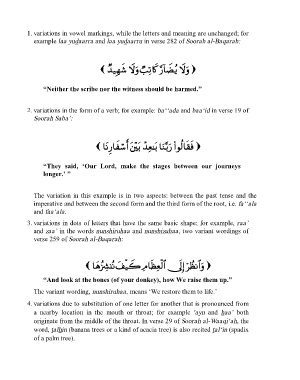
1. variations in vowel markings, while the letters and meaning are unchanged; for
example laa yudaarra and laa yudaarru in verse 282 of Soorah al-Baqarah:
( ÓÎgx© wur Ò=Ï?%x. §!$Òã wur )
“Neither the scribe nor the witness should be harmed.”
2. variations in the form of a verb; for example: ba‘‘ada and baa‘id in verse 19 of
Soorah Saba’:
( $tRÍ$xÿór& tû÷üt/ ôÏè»t/ $uZ/u (#qä9$s)sù )
“They said, ‘Our Lord, make the stages between our journeys
longer.’ ”
The variation in this example is in two aspects: between the past tense and the
imperative and between the second form and the third form of the root, i.e. fa‘‘ala
and faa‘ala.
3. variations in dots of letters that have the same basic shape; for example, raa’
and zaa’ in the words nunshiruhaa and nunshizuhaa, two variant wordings of
verse 259 of Soorah al-Baqarah:
( $ydãų^çR y#ø2 ÏQ$sàÏèø9$# n<Î) öÝàR$#ur )
“And look at the bones (of your donkey), how We raise them up.”
The variant wording, nunshiruhaa, means ‘We restore them to life.’
4. variations due to substitution of one letter for another that is pronounced from
a nearby location in the mouth or throat; for example 'ayn and haa’ both
originate from the middle of the throat. In verse 29 of Soorah al-Waaqi‘ah, the
word, talhin (banana trees or a kind of acacia tree) is also recited tal‘in (spadix
of a palm tree).
http://www.islamiconlineuniversity.com 14

