


Page 156 - Tafsir of surat at tawba repentance
P. 156
© Islamic Online University Usool at-Tafseer
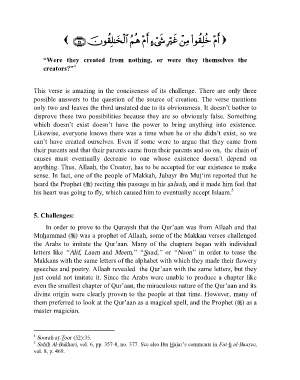
( ÇÌÎÈ cqà)Î=»yø9$# ãNèd ÷Pr& >äóÓx« Îöxî ô`ÏB (#qà)Î=äz ÷Pr& )
“Were they created from nothing, or were they themselves the
4
creators?”
This verse is amazing in the conciseness of its challenge. There are only three
possible answers to the question of the source of creation. The verse mentions
only two and leaves the third unstated due to its obviousness. It doesn’t bother to
disprove these two possibilities because they are so obviously false. Something
which doesn’t exist doesn’t have the power to bring anything into existence.
Likewise, everyone knows there was a time when he or she didn’t exist, so we
can’t have created ourselves. Even if some were to argue that they came from
their parents and that their parents came from their parents and so on, the chain of
causes must eventually decrease to one whose existence doesn’t depend on
anything. Thus, Allaah, the Creator, has to be accepted for our existence to make
sense. In fact, one of the people of Makkah, Jubayr ibn Mut‘im reported that he
heard the Prophet (r) reciting this passage in his salaah, and it made him feel that
5
his heart was going to fly, which caused him to eventually accept Islaam.
5. Challenges:
In order to prove to the Quraysh that the Qur’aan was from Allaah and that
Muhammad (r) was a prophet of Allaah, some of the Makkan verses challenged
the Arabs to imitate the Qur’aan. Many of the chapters began with individual
letters like “Alif, Laam and Meem,” “Saad,” or “Noon” in order to tease the
Makkans with the same letters of the alphabet with which they made their flowery
speeches and poetry. Allaah revealed the Qur’aan with the same letters, but they
just could not imitate it. Since the Arabs were unable to produce a chapter like
even the smallest chapter of Qur’aan, the miraculous nature of the Qur’aan and its
divine origin were clearly proven to the people at that time. However, many of
them preferred to look at the Qur’aan as a magical spell, and the Prophet (r) as a
master magician.
4
Soorah at-Toor (52):35.
5
Sahih Al-Bukhari, vol. 6, pp. 357-8, no. 377. See also Ibn Hajar’s comments in Fat-h al-Baaree,
vol. 8, p. 469.
http://www.islamiconlineuniversity.com 6

