


Page 151 - Tafsir of surat at tawba repentance
P. 151
© Islamic Online University Usool at-Tafseer
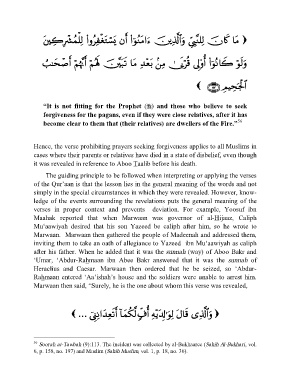
tûüÅ2Îô³ßJù=Ï9 (#rãÏÿøótGó¡o br& (#þqãZtB#uä úïÏ%©!$#ur ÄcÓÉ<¨Z=Ï9 c%x. $tB )
Ü=»ysô¹r& öNåk¨Xr& öNçlm; ú¨üt7s? $tB Ï÷èt/ .`ÏB 2n1öè% Í<'ré& (#þqçR%2 öqs9ur
( ÇÊÊÌÈ ÉOÅspgø:$#
“It is not fitting for the Prophet (r) and those who believe to seek
forgiveness for the pagans, even if they were close relatives, after it has
56
become clear to them that (their relatives) are dwellers of the Fire.”
Hence, the verse prohibiting prayers seeking forgiveness applies to all Muslims in
cases where their parents or relatives have died in a state of disbelief, even though
it was revealed in reference to Aboo Taalib before his death.
The guiding principle to be followed when interpreting or applying the verses
of the Qur’aan is that the lesson lies in the general meaning of the words and not
simply in the special circumstances in which they were revealed. However, know-
ledge of the events surrounding the revelations puts the general meaning of the
verses in proper context and prevents deviation. For example, Yoosuf ibn
Maahak reported that when Marwaan was governor of al-Hijaaz, Caliph
Mu‘aawiyah desired that his son Yazeed be caliph after him, so he wrote to
Marwaan. Marwaan then gathered the people of Madeenah and addressed them,
inviting them to take an oath of allegiance to Yazeed ibn Mu‘aawiyah as caliph
after his father. When he added that it was the sunnah (way) of Aboo Bakr and
‘Umar, ‘Abdur-Rahmaan ibn Abee Bakr answered that it was the sunnah of
Heraclius and Caesar. Marwaan then ordered that he be seized, so ‘Abdur-
Rahmaan entered ‘Aa’ishah’s house and the soldiers were unable to arrest him.
Marwaan then said, “Surely, he is the one about whom this verse was revealed,
( … ûÓÍ_ÏR#yÏès?r& !$yJä3©9 7e$é& Ïm÷t$Î!ºuqÏ9 tA$s% Ï%©!$#ur )
56
Soorah at-Tawbah (9):113. The incident was collected by al-Bukhaaree (Sahih Al-Bukhari, vol.
6, p. 158, no. 197) and Muslim (Sahih Muslim, vol. 1, p. 18, no. 36).
http://www.islamiconlineuniversity.com 32

