


Page 181 - Tafsir of surat at tawba repentance
P. 181
© Islamic Online University Usool at-Tafseer
some of the soorahs of the Qur’aan begin have no obvious meanings in
themselves. Although they were used in ancient Arabic poetry, they were never
used at the beginnings of verses, and the context would always indicate the
intended meanings. An example of that can be found in the following couplet of
Arabic poetry:
ق : ْﺖَﻟﺎﻘَﻓ ، ْﻲِﻔِﻗ : ﺎَﮭَﻟ ﺎَﻨْﻠُﻗ
2
Qulnaa lahaa: qifee, fa qaalat: qaaf
(We said to her, “Stop,” and she said, “Qaaf.” [short for waqaftu, “I have
stopped.”])
However, with regard to the Qur’aan, it has been noted by the early scholars
that there is a mathematical relationship between the introductory letters and their
occurrence in their respective soorahs, as well as in the other soorahs of the
Qur’aan itself. For an illustrative example, let us examine Soorah Qaaf, which
begins as follows:
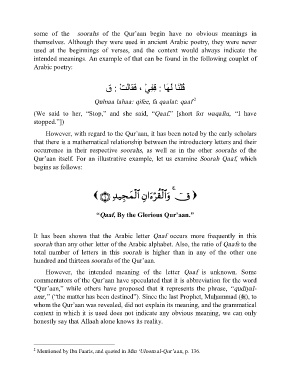
( ÇÊÈ ÏÉfyJø9$# Éb#uäöà)ø9$#ur 4 úX )
“Qaaf, By the Glorious Qur’aan.”
It has been shown that the Arabic letter Qaaf occurs more frequently in this
soorah than any other letter of the Arabic alphabet. Also, the ratio of Qaafs to the
total number of letters in this soorah is higher than in any of the other one
hundred and thirteen soorahs of the Qur’aan.
However, the intended meaning of the letter Qaaf is unknown. Some
commentators of the Qur’aan have speculated that it is abbreviation for the word
“Qur’aan,” while others have proposed that it represents the phrase, “qudiyal-
amr,” (“the matter has been destined”). Since the last Prophet, Muhammad (r), to
whom the Qur’aan was revealed, did not explain its meaning, and the grammatical
context in which it is used does not indicate any obvious meaning, we can only
honestly say that Allaah alone knows its reality.
2
Mentioned by Ibn Faaris, and quoted in Min ‘Uloom al-Qur’aan, p. 136.
http://www.islamiconlineuniversity.com 4

