


Page 185 - Tafsir of surat at tawba repentance
P. 185
© Islamic Online University Usool at-Tafseer
evolved from the muhkamaat verses. The early scholars concentrated on those
verses which had direct relevance to human actions, the verses which could be
applied and interpreted according to logical and universally acceptable
grammatical principles. However, those who sought to destroy the message of
Islaam from within began their attack at the very source, the Qur’aan. The
muhkamaat verses do not lend themselves to philosophical interpretations. Hence,
the mutashaabihaat became the pillars upon which counter-Islaam was built, and
Allaah’s names and attributes became the starting point. For example, Allaah
describes Himself in Qur’aan as al-Baseer, the Seer, and as-Samee‘, the Hearer,
among His many names and attributes. During the era of the Prophet (r) and
that of the four Righteous Caliphs after his death, the sahaabah understood the
verses containing these attributes according to their obvious meanings without
delving into the why and the hows. To them, Allaah sees and hears all things
without resembling His creation in any way. However, after the era of the
sahaabah, the argument was raised by some that seeing and hearing were human
or animal characteristics which required particular sensory apparatuses not
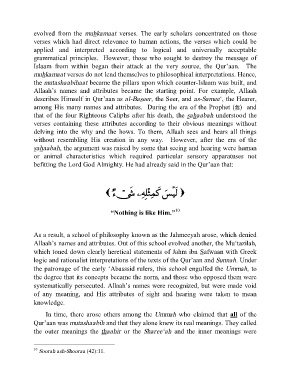
befitting the Lord God Almighty. He had already said in the Qur’aan that:
( Öäïx« ¾ÏmÎ=÷WÏJx. }§øs9 )
10
“Nothing is like Him.”
As a result, a school of philosophy known as the Jahmeeyah arose, which denied
Allaah’s names and attributes. Out of this school evolved another, the Mu‘tazilah,
which toned down clearly heretical statements of Jahm ibn Safwaan with Greek
logic and rationalist interpretations of the texts of the Qur’aan and Sunnah. Under
the patronage of the early ‘Abasssid rulers, this school engulfed the Ummah, to
the degree that its concepts became the norm, and those who opposed them were
systematically persecuted. Allaah’s names were recognized, but were made void
of any meaning, and His attributes of sight and hearing were taken to mean
knowledge.
In time, there arose others among the Ummah who claimed that all of the
Qur’aan was mutashaabih and that they alone knew its real meanings. They called
the outer meanings the thaahir or the Sharee‘ah and the inner meanings were
10
Soorah ash-Shooraa (42):11.
http://www.islamiconlineuniversity.com 8

