


Page 75 - Tafsir of surat at tawba repentance
P. 75
© Islamic Online University Usool at-Tafseer
Case One:
One critic writes: “Calling together or ripping apart? In the process of
creation, heaven and earth were first apart and are called to come together
[41:11], while 21:30 states they were originally one piece and then ripped apart.”
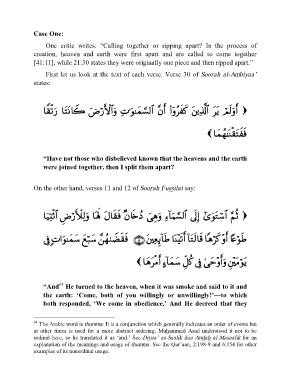
First let us look at the text of each verse. Verse 30 of Soorah al-Ambiyaa’
states:
$Z)ø?u $tFtR%2 uÚöF{$#ur ÏNºuq»yJ¡¡9$# ¨br& (#ÿrãxÿx. tûïÏ%©!$# tt óOs9urr& )
( $yJßg»oYø)tFxÿsù
“Have not those who disbelieved known that the heavens and the earth
were joined together, then I split them apart?
On the other hand, verses 11 and 12 of Soorah Fussilat say:
$uÏKø$# ÇÚöF|Ï9ur $olm; tA$s)sù ×b%s{ß }Édur Ïä!$uK¡¡9$# n<Î) #uqtGó$# §NèO )
Îû ;N#uq»yJy yìö7y £`ßg9Òs)sù ÇÊÊÈ tûüÏèͬ!$sÛ $oY÷s?r& !$tGs9$s% $\döx. ÷rr& %·æöqsÛ
( $ydtøBr& >ä!$yJy Èe@ä. Îû 4ym÷rr&ur Èû÷ütBöqt
64
“And He turned to the heaven, when it was smoke and said to it and
the earth: ‘Come, both of you willingly or unwillingly!’—to which
both responded, ‘We come in obedience.’ And He decreed that they
64
The Arabic word is thumma. It is a conjunction which generally indicates an order of events but
at other times is used for a more abstract ordering. Muhammad Asad understood it not to be
ordinal here, so he translated it as ‘and.’ See Diyaa’ as-Saalik ilaa Awdah al-Masaalik for an
explanation of the meanings and usage of thumma. See the Qur’aan, 2:198-9 and 6:154 for other
examples of its nonordinal usage.
http://www.islamiconlineuniversity.com 27

