


Page 134 - Robot Design Handbook ROBOCON Malaysia 2019
P. 134
Aluminium is used as it is light, easy to process yet very durable. The weight limit for this

               competition  is  50  kg  which  means  the  selection  material  is  very  crucial.  Four
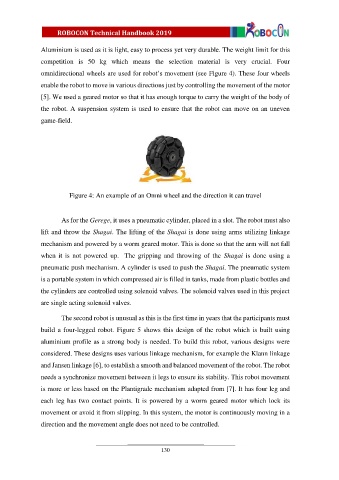
               omnidirectional wheels are used for robot’s movement (see Figure 4). These four wheels

               enable the robot to move in various directions just by controlling the movement of the motor
               [5]. We used a geared motor so that it has enough torque to carry the weight of the body of

               the robot. A suspension system is used to ensure that the robot can move on an uneven

               game-field.


                         Figure 4: An example of an Omni wheel and the direction it can travel


                       As for the Gerege, it uses a pneumatic cylinder, placed in a slot. The robot must also

               lift and throw the Shagai. The lifting of the Shagai is done using arms utilizing linkage

               mechanism and powered by a worm geared motor. This is done so that the arm will not fall
               when  it  is  not  powered  up.    The  gripping  and  throwing  of  the  Shagai  is  done  using  a

               pneumatic push mechanism. A cylinder is used to push the Shagai. The pneumatic system
               is a portable system in which compressed air is filled in tanks, made from plastic bottles and

               the cylinders are controlled using solenoid valves. The solenoid valves used in this project

               are single acting solenoid valves.

                       The second robot is unusual as this is the first time in years that the participants must

               build a four-legged robot.  Figure 5 shows  this  design of the robot which  is  built  using
               aluminium profile as a strong body is needed. To build this robot, various designs were

               considered. These designs uses various linkage mechanism, for example the Klann linkage
               and Jansen linkage [6], to establish a smooth and balanced movement of the robot. The robot

               needs a synchronize movement between it legs to ensure its stability. This robot movement
               is more or less based on the Plantigrade mechanism adapted from [7]. It has four leg and

               each leg has two contact points.  It is powered  by a worm geared motor which lock its

               movement or avoid it from slipping. In this system, the motor is continuously moving in a
               direction and the movement angle does not need to be controlled.


                                                          130

