


Page 34 - IIUM Press Rights Catalogue 2020
P. 34
32


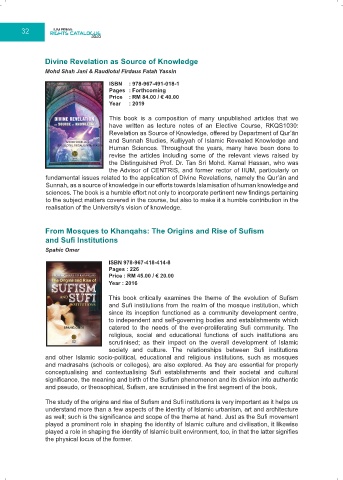
              Divine Revelation as Source of Knowledge
              Mohd Shah Jani & Raudlotul Firdaus Fatah Yassin
                                 ISBN   : 978-967-491-018-1
                                 Pages  : Forthcoming
                                 Price  : RM 84.00 / € 40.00
                                 Year   : 2019

                                 This book is a composition  of many unpublished  articles that we
                                 have  written  as  lecture  notes  of  an  Elective  Course,  RKQS1030:
                                 Revelation as Source of Knowledge, offered by Department of Qur’ān
                                 and Sunnah Studies, Kulliyyah of Islamic Revealed Knowledge and
                                 Human Sciences. Throughout the years, many have been done to
                                 revise the articles including  some of the relevant views raised by
                                 the Distinguished Prof. Dr. Tan Sri Mohd. Kamal Hassan, who was
                                 the Advisor of CENTRIS, and former rector of IIUM, particularly on
              fundamental issues related to the application of Divine Revelations, namely the Qur’ān and
              Sunnah, as a source of knowledge in our efforts towards Islamisation of human knowledge and
              sciences. The book is a humble effort not only to incorporate pertinent new findings pertaining
              to the subject matters covered in the course, but also to make it a humble contribution in the
              realisation of the University’s vision of knowledge.


              From Mosques to Khanqahs: The Origins and Rise of Sufism
              and Sufi Institutions
              Spahic Omer
                                 ISBN 978-967-418-414-8
                                 Pages : 226
                                 Price : RM 45.00 / € 20.00
                                 Year : 2016
                                 This  book  critically  examines  the  theme  of  the  evolution  of  Sufism
                                 and Sufi institutions from the realm of the mosque institution, which
                                 since its inception functioned as a community development  centre,
                                 to independent and self-governing bodies and establishments which
                                 catered  to  the  needs  of  the  ever-proliferating  Sufi  community.  The
                                 religious,  social and educational functions of such institutions are
                                 scrutinised; as their impact on the overall development  of Islamic
                                 society  and  culture.  The  relationships  between  Sufi  institutions
              and  other  Islamic  socio-political,  educational  and  religious  institutions,  such  as  mosques
              and madrasahs (schools or colleges), are also explored. As they are essential for properly
              conceptualising  and  contextualising  Sufi  establishments  and  their  societal  and  cultural
              significance, the meaning and birth of the Sufism phenomenon and its division into authentic
              and pseudo, or theosophical, Sufism, are scrutinised in the first segment of the book.
              The study of the origins and rise of Sufism and Sufi institutions is very important as it helps us
              understand more than a few aspects of the identity of Islamic urbanism, art and architecture
              as well; such is the significance and scope of the theme at hand. Just as the Sufi movement
              played a prominent role in shaping the identity of Islamic culture and civilisation, it likewise
              played a role in shaping the identity of Islamic built environment, too, in that the latter signifies
              the physical locus of the former.

