


Page 35 - IIUM Press Rights Catalogue 2020
P. 35
33


              The book is divided into four chapters. The first chapter discusses the substance of authentic
              Sufism  and  what  sets  it  apart  from  both  pseudo  Sufism  and  mysticism.  Several  parallels
              between  authentic  Sufism  and  mainstream  Islamic  spirituality  and  scholarship  are  drawn.
              The second chapter deals with the genesis and meaning of pseudo, or theosophical, Sufism,
              and why as a repugnant innovation it is incompatible with the main body of Islamic teachings
              and values. Foremost manifestations of pseudo Sufism, such as excessive asceticism and
              monasticism, religious laxity, and an evolution from religious innovations to heretical beliefs,
              are presented and repudiated.

              The third chapter delves into the subject matter of the origins and rise of Sufi institutions. The
              discussion revolves around the impact of the mosque institution and the decentralisation of
              its multifaceted roles and functions, which themselves evolved into independent bodies and
              establishments, on the emergence of first independent Sufi institutions, such as duwayrahs,
              ribats, khanqahs, zawiyahs and tekkes. Critical phases in the evolution of Sufi institutions and
              their most important features are looked at. The main aspects of the Sufi life and activities in
              early Sufi institutions are also examined.

              Finally, in the fourth chapter, the main reasons which caused and sustained the continuous
              existence  of  Sufism  and  Sufi  institutions  are  explored.  Four  such  factors  are  dwelled  on,
              namely, the Turkish factor, the Persian factor, the Shi’ah factor, and the ahl al-sunnah wa al-
              jama’ah factor.


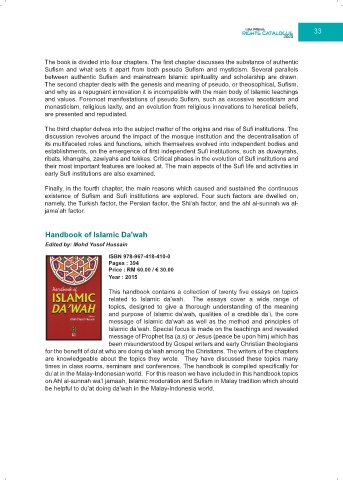
              Handbook of Islamic Da'wah
              Edited by: Mohd Yusof Hussain
                                 ISBN 978-967-418-410-0
                                 Pages : 394
                                 Price : RM 60.00 / € 30.00
                                 Year : 2015
                                 This handbook contains a collection of twenty five essays on topics
                                 related  to  Islamic  da’wah.    The  essays  cover  a  wide  range  of
                                 topics, designed to give a thorough understanding  of the meaning
                                 and purpose of Islamic da’wah, qualities of a credible da’i, the core
                                 message of Islamic da’wah as well as the method and principles of
                                 Islamic da’wah. Special focus is made on the teachings and revealed
                                 message of Prophet Isa (a.s) or Jesus (peace be upon him) which has
                                 been misunderstood by Gospel writers and early Christian theologians
              for the benefit of du’at who are doing da’wah among the Christians. The writers of the chapters
              are knowledgeable about the topics they wrote.  They have discussed these topics many
              times in class rooms, seminars and conferences. The handbook is compiled specifically for
              du’at in the Malay-Indonesian world.  For this reason we have included in this handbook topics
              on Ahl al-sunnah wa’l jamaah, Islamic moderation and Sufism in Malay tradition which should
              be helpful to du’at doing da’wah in the Malay-Indonesia world.

