


Page 55 - IIUM Press Rights Catalogue 2020
P. 55
53


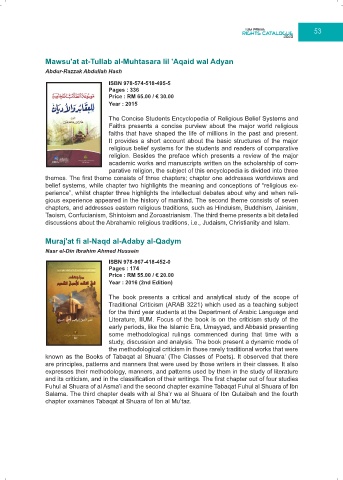
              Mawsu'at at-Tullab al-Muhtasara lil 'Aqaid wal Adyan
              Abdur-Razzak Abdullah Hash
                                 ISBN 978-574-518-495-5
                                 Pages : 336
                                 Price : RM 65.00 / € 30.00
                                 Year : 2015

                                 The Concise Students Encyclopedia of Religious Belief Systems and
                                 Faiths presents a concise purview about the major world religious
                                 faiths that have shaped the life of millions in the past and present.
                                 It provides a short account about the basic structures of the major
                                 religious belief systems for the students and readers of comparative
                                 religion. Besides the preface which presents a review of the major
                                 academic works and manuscripts written on the scholarship of com-
                                 parative religion, the subject of this encyclopedia is divided into three
              themes. The first theme consists of three chapters; chapter one addresses worldviews and
              belief systems, while chapter two highlights the meaning and conceptions of “religious ex-
              perience”, whilst chapter three highlights the intellectual debates about why and when reli-
              gious experience appeared in the history of mankind. The second theme consists of seven
              chapters, and addresses eastern religious traditions, such as Hinduism, Buddhism, Jainism,
              Taoism, Confucianism, Shintoism and Zoroastrianism. The third theme presents a bit detailed
              discussions about the Abrahamic religious traditions, i.e., Judaism, Christianity and Islam.

              Muraj'at fi al-Naqd al-Adaby al-Qadym
              Nasr el-Din Ibrahim Ahmed Hussein
                                 ISBN 978-967-418-452-0
                                 Pages : 174
                                 Price : RM 55.00 / € 20.00
                                 Year : 2016 (2nd Edition)
                                 The book presents a critical and analytical  study of the scope of
                                 Traditional Criticism (ARAB 3221) which used as a teaching subject
                                 for the third year students at the Department of Arabic Language and
                                 Literature, IIUM. Focus of the book is on the criticism study of the
                                 early periods, like the Islamic Era, Umayyad, and Abbasid presenting
                                          ISBN 978-967-418-452-0
                                 some methodological rulings  commenced  during  that time with a
                                         9 789674 184520
                                 study, discussion and analysis. The book present a dynamic mode of
                                 the methodological criticism in those rarely traditional works that were
              known as the Books of Tabaqat al Shuara’ (The Classes of Poets). It observed that there
              are principles, patterns and manners that were used by those writers in their classes. It also
              expresses their methodology, manners, and patterns used by them in the study of literature
              and its criticism, and in the classification of their writings. The first chapter out of four studies
              Fuhul al Shuara of al Asma’i and the second chapter examine Tabaqat Fuhul al Shuara of Ibn
              Salama. The third chapter deals with al Sha’r wa al Shuara of Ibn Qutaibah and the fourth
              chapter examines Tabaqat al Shuara of Ibn al Mu’taz.

