


Page 29 - CMA PROfiles Winter 2018
P. 29
The mystery


             of making stuff


            In his follow-up post, “Further Thoughts on the Very Picky
            Customer,” Paul Downs also reflected on the perceptions
            that those in the business have to combat, and we thought
            his comments would resonate with CMA members:

               … Many people don’t realize how difficult it is to build
               physical objects. Making stuff used to be far more   furniture was made entirely of solid wood and used
               familiar. Almost everything a Colonial farmer owned was   traditional joinery throughout. When we started making
               either homemade or made by someone close by. These   big tables, we had to change the way we made things
               kinds of objects have a simplicity that we enjoy, and the   because the market demanded a different product than
               processes that produce them are easy to understand,   those techniques and materials could provide. Today,
               and, with some effort, duplicate ourselves. But there is   in a business environment, the tables need to look
               another class of objects that are ubiquitous in our lives   polished and refined in order to fit in with tech-heavy
               that cannot be made at home. These products require   interiors. This meant more machine work, less hand
               sophisticated systems of machines and highly refined   work. Aspects of the project that used to be irrelevant,
               materials, and draw on global supply chains that no   like fabrication speed and ease of shipment, became
               one person could master. Obvious examples are our   paramount.
               cars, airplanes, and everything electronic: computers,   Now, the things we make require a combination of
               phones, cameras — even mundane objects like the plas-  extremely sophisticated design and manufacturing
               tic bottle that holds your soda or water.          along with highly skilled hand work. I have had to design

                                                                  a work flow, from initial phone call to delivery, that
               So many of the things we hold and use are designed
               and built to standards that are unachievable by human   solves a long list of problems aside from how to get
               hands. And their existence alters our perception of the   the top to sit perfectly flat. Some of these solutions are
               things that are still handmade. Commonplace variations   mutually exclusive, and the need to deliver our products
               now look like defects. If you go to a museum and take   at a competitive price means that oversolving one can
               a careful look at the furniture there, you will see that   shortchange another. A lot of the value we deliver to
               what you take for straight lines and flat surfaces are   our clients is in the space between the edge of the table
               actually not straight or flat at all. The tools, materials,   and the wall. Getting that distance right is as important
               and techniques that gave birth to those things don’t   as making the top perfectly flat.
               allow for perfect geometry. Now go to your local store   The challenge, of course, is to complete the list before
               and look at a stack of plastic deck chairs, the cheap ones   you run out of money. Clients have budgets and
               that nest on each other. You will see complex curves   expectations, and it is the job of the manufacturer to
               and near-perfect geometric shapes, with no evidence   balance the two. Sometimes that means educating
               whatsoever that humans made them.                  clients as to why their expectations are unrealistic.

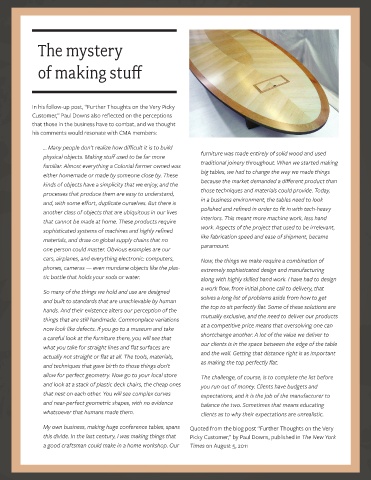
               My own business, making huge conference tables, spans   Quoted from the blog post “Further Thoughts on the Very
               this divide. In the last century, I was making things that   Picky Customer,” by Paul Downs, published in The New York
               a good craftsman could make in a home workshop. Our   Times on August 5, 2011


                                                                                                CABINET MAKERS ASSOCIATION   27

