


Page 42 - GeoPRISMS_Newsletter_Spring2018_Neat
P. 42
Early-Career Scientists/Faculty:

        Introduction to GeoPRISMS/MARGINS data resources,

        mini-Lessons, and effective broader impacts


        Conveners: Andrew Goodwillie (Lamont-IEDA), Julia Morgan (Rice University)

        Early-career members of the GeoPRISMS community including  and balanced suite of learning modules that highlights key results
        graduate students, post-docs and recently-appointed faculty  of the MARGINS program, as well as some early results of the
        often seek help in three areas: in generating ideas for successful  GeoPRISMS SCD and of RIE initiatives. The mini-lessons enable
        broader impacts, in finding reliable sources of material for their  data-rich learning opportunities for upper-level undergraduate
        class exercises, and in locating effective data tools relevant for their  students and provide a valuable resource to educators interested in
        research and teaching. This workshop aimed to provide guidance and  continental margins research. Juli Morgan discussed the Rift Basin
        pointers on these topics, and aimed to show how the GeoPRISMS-  Morphology module as an example of bringing RCL science into the
        hosted MARGINS mini-lessons could be used as a vehicle to explore  classroom. Eliza Richardson and Jeff Marshall summarized SEIZE
        each aspect.                                           initiative mini-lesson modules covering Slow-Slip Events. Bob Stern
        Following an introduction by GeoPRISMS Office chair Demian   and Jeff Ryan described SubFac modules that tackle active tectonics
        Saffer, this half-day workshop proceeded with demonstrations from   and geochemical studies at the Marianas and Central America
        the NSF-funded IRIS, UNAVCO and IEDA data facilities of data   subduction systems.
        tools and resources that are relevant for GeoPRISMS.   The final part of the workshop was a round-table discussion of

        John Taber, IRIS director of education and public outreach,   strategies to improve the impact and effectiveness of proposed
        presented IRIS data tools including Seismic Monitor (http://  Broader Impacts, with a focus on the generation of community
        ds.iris.edu/seismon/) which displays near real-time earthquake   accessible mini-lessons and data sets.
        information, the Earthquake Teachable Moments slide packets  More than thirty participants from a range of fields registered for
        (https://www.iris.edu/hq/retm/), IRIS Ground Motion Visualization  the event. The conveners thank GeoPRISMS for arranging this mini-
        GMV animations (http://ds.iris.edu/ds/products/gmv/), the IRIS  workshop at the Fall AGU meeting.
        3-D Earthquake Browser (http://ds.iris.edu/ieb/), a seismic wave
        propagation visualization tool (http://ds.iris.edu/seismon/swaves/),
        and the jAmaSeis realtime seismic data display (https://www.iris.
        edu/hq/inclass/software-web-app/jamaseis).
        UNAVCO’s Shelley Olds described the Short Courses for advancing
        technical expertise which cover topics including GPS and InSAR data
        processing, and Terrestrial Laser Scanning (https://www.unavco.org/
        education/professional-development/short-courses/2018/2018.html).
        The GETSI peer-reviewed teaching modules were shown (https://
        serc.carleton.edu/getsi/index.html). Her presentation also provided                                          Photos by A. Férot
        a demonstration of the GPS Velocity Viewer web interface (https://
        www.unavco.org/software/visualization/GPS-Velocity-Viewer/
        GPS-Velocity-Viewer.html).

        Andrew Goodwillie from the IEDA facility demonstrated the NSF
        Data Management Plan Tool (Data Search using EarthChem (http://
        www.earthchem.org/portal) and MGDS (http://www.marine-geo.
        org/tools/new_search/search_map.php), and the GeoMapApp data
        discovery and visualization tool (http://www.geomapapp.org/).
        Former GeoPRISMS Office chair and lead PI on the MARGINS
        mini-lessons project Juli Morgan introduced the rationale behind the
        mini-lesson modules (http://geoprisms.org/education/mini-lessons/).                                          Photos by A. Férot
        They were designed to integrate in undergraduate geoscience
        curricula the critical new MARGINS observations and insights
        of fundamental geological processes along continental margins.
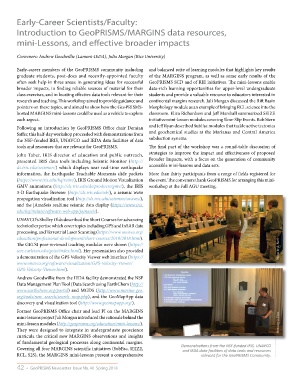
        Covering all four MARGINS scientific initiatives (SubFac, SEIZE,     Demonstrations from the NSF-funded IRIS, UNAVCO
                                                                             and IEDA data facilities of data tools and resources
        RCL, S2S), the MARGINS mini-lessons present a comprehensive                  relevant for the GeoPRISMS Community.

        42  •  GeoPRISMS Newsletter  Issue No. 40  Spring 2018

