


Page 43 - GeoPRISMS_Newsletter_Spring2018_Neat
P. 43
Amphibious community experiments in Alaska

        and related opportunities

         Conveners: Geoff Abers (Cornell University), Aubreya Adams (Colgate University), Emily Roland (University of Washington), Susan
         Schwartz (UC Santa Cruz), Spahr Webb (LDEO, Columbia University), Lindsay Worthington (University of New Mexico)

        73 scientists met in New Orleans in advance of the AGU Fall  Following the introduction by members of the AACSE PI team,
        Meeting to discuss the current status and plans for the Alaska  scientists from across the community gave updates on related
        Amphibious Community Seismic Experiment (AACSE). Attendees  studies and highlighted opportunities to leverage the AACSE. Jeff
        encompassed a broad spectrum of marine and onshore science  Freymueller (AVO) gave insights into monitoring of volcanic activity
        backgrounds including representatives from GeoPRISMS, NSF, IRIS,  and volcano seismology along the entire subduction area and updates
        the Alaska Volcano Observatory, and academic institutions across  on upgrades to the AVO monitoring network. Shanshan Li (UAF)
        the US and abroad. Graduate students and early career scientists  reviewed recent geodesy studies and investigations of locked and
        were particularly well represented in the audience. After a brief  creeping sections of the subduction interface.
        introduction from GeoPRISMS Chair Demian Saffer and workshop   Members of the broader community then presented a series of
        co-Chair Aubreya Adams, AACSE lead-PI Geoff Abers reviewed   lightning talks, highlighting related projects in Alaska and other
        previous work in the Alaskan subduction zone and highlights of   regions of subduction. Carl Tape (UAF) gave updates following the
        the preceding community amphibious array, the Cascadia Initiative.  demobilization of the SALMON network, providing insights into
        Workshop co-Chair Emily Roland provided a history of the AACSE  the unique challenges of field work in this region and into designing
        and plans for execution of the project. Data collection will commence  bear-resistant stations. Kerry Key (LDEO) showed preliminary results
        in 2018 with onshore deployments in May and June, and offshore  from a joint ocean-bottom magnetotelluric data and onshore seismic
        deployment in two cruise legs. Leg 1 (co-chiefs Spahr Webb and   from Okmok Volcano in the eastern Aleutian Islands. Terry Plank
        Lindsay Worthington) will sail from May 9-29 and Leg 2 (co-chiefs   (LDEO) reviewed recent geochemical studies of magma ascent and
        Anne Sheehan and Doug Wiens) will sail from July 11-25. The array   volatiles in Aleutian volcanoes. Dave Chadwell (SCRIPPS) discussed
        footprint extends along strike from Kodiak Island to the Shumagin   the use of seafloor geodesy to study locking and creeping patches of
        Islands, and from the onshore backarc to the outer rise 250 km   the subduction interface. Harold Tobin (U. of Wisconsin) presented
        past the trench. A total of 75 ocean-bottom seismometers will be   SZ4D, focusing on the status of that initiative, and how insights from
        deployed, including twenty in shallow water with trawl-resistant   the AACSE could inform subduction zone science across the globe.
        design. Thirty broadband sensors will be deployed onshore to  Community discussion after the talks focused on encouraging
        complement the ongoing EarthScope Transportable Array. In 2019  feedback for improvement of the implementation plan and
        a high-density nodal array will be deployed along the 50 km road  reinforcing the ongoing charge of how we use the AACSE to better
        system on Kodiak. All data will become open through the IRIS Data  understand subduction zones on a global scale. Steps toward this
        Management Center immediately upon recovery and pre-processing.  goal include a focus on instrumenting seismic gaps in order to
        Roland also highlighted opportunities for community engagement,  span critical boundaries in seismic behavior, as well as linking new
        including the opening of the Apply-to-Sail program to scientists  observations to numerical, theoretical, and conceptual models. Other
        from all career stages. By the January 2018 deadline, a total of 47  measurements such as heat flow, sea-floor pressure measurements,
        graduate students, postdocs, faculty, and geoscience professionals  and magnetotelluric surveys will be key in addressing these aims and
        applied for twelve available berths. Applications will reopen in late  could motivate complementary experiments. Attendees noted the
        2018 for the 2019 recovery cruises, one of which will be reserved  need to have a response plan in place in the case of a large volcanic
        for undergraduate participants.                         eruption or earthquake during the deployment.
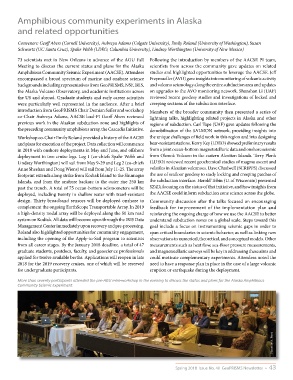
        More than seventy participants attended the pre-AGU mini-workshop in the evening to discuss the status and plans for the Alaska Amphibious
        Community Seismic Experiment.


                                                                                                                   Photos by A. Férot


                                                                          Spring 2018  Issue No. 40  GeoPRISMS Newsletter  •  43

