


Page 20 - GeoPRISMS_Newsletter_Spring2019_42_Neat
P. 20
Report on the2019 GeoPRISMS Synthesis and Integration


        Theoretical and Experimental Institute


        Organizing Committee
        Lead Conveners: Harm Van Avendonk (University of Texas, Austin) & Katherine A. Kelley (University of Rhode Island)
        Co-Conveners: Josef Dufek (University of Oregon), Rob Harris (Oregon State University), Ikuko Wada (University of
        Minnesota), Jessica Warren (University of Delaware), Phil Skemer (Washington University), Kyle Straub (Tulane University),
        Demian Saffer (The Pennsylvania State University; ex officio)
        Early Career Symposium Conveners: Taryn Lopez (University of Alaska) & Eric Mittelstaedt (University of Idaho)


              he GeoPRISMS Synthesis & Integration Theoretical and Experimental Institute (TEI) was held at the Menger Hotel in San Antonio,
              TX from Feb 26-Mar 1, 2019, fittingly the same site as the MARGINS Successor Planning Workshop that initially defined the
        Tscope of the GeoPRISMS program in 2010. Objectives of the meeting included summarizing progress on GeoPRISMS science
        over the past decade, defining the future efforts needed to integrate and synthesize the multi-disciplinary outcomes of the program, and
        positioning the community for an engaging and sustainable future beyond the end of GeoPRISMS.
        To achieve these goals, we assembled a diverse team of conveners, speakers, and group leaders, and developed an agenda that focused
        on science themes common to both the Rift Initiation and Evolution (RIE) and Subduction Cycles and Deformation (SCD) Initiatives of
        the GeoPRISMS program. The meeting attracted 170 participants, seventy of whom were students and post-docs. More than a hundred
        participants brought posters for presentation in the evenings or during coffee breaks during daytime sessions.

        The meeting structure aimed to bring the RIE and SCD communities together through a series of paired keynote talks under unifying
        themes of Deformation at all Timescales, Mass Fluxes, and Geohazards. Early-career participants engaged in a half-day pre-TEI symposium,
        and led breakout discussions and reporting to the main group during the TEI. Together, this mix infused the meeting with both legacy
        and fresh perspectives on how far our science has come and where our community should go in the future. Short talks on allied science
        programs, data legacy, education and outreach, and models/programs for future community engagement set the stage for discussions of
        GeoPRISMS synthesis and consideration of ways our community could move forward.

                                                 Science overview

                                                 Early CarEEr SympoSium
                                                 A half-day Early Career Symposium (ECS) served as a lead-up to the TEI. This event
                                                 provided opportunities for early-career TEI participants to participate in networking
                                                 and to offer advance exposure to TEI themes and questions in order to promote and
                                                 enhance participation in group discussions during the main TEI. The ECS attracted 64
                                                 early-career participants ranging from undergraduates to pre-tenured faculty, spanning
                                                 a range of expertise including rock mechanics, geodynamic modeling, seismology,
                                                 geochemistry, structural geology, geodesy, and magnetotellurics. The symposium
                                                 included a series of talks and group breakout sessions. A multi-disciplinary team of
                                                 three to four ECS participants assembled each talk through pre-meeting interactions.
                                                 Following each talk, the participants split into pre-assigned discussion groups to
                                                 ensure representation from all three TEI themes, and were tasked with addressing two
                                                 questions: 1) what are the remaining or emerging science questions related to this TEI
                                                 theme, and 2) what infrastructure, data and/or synthesis do we need to address the
                                                 core questions? Within each group, first participants paired up to discuss the question,
                                                 then each pair would join another pair for discussion among four participants, then
                                                 eight participants, and finally the entire group. During each discussion interval the   Photo by T. Fischer
                                                 pair or group selected the most important question or synthesis goal. This style of
                                                 breakout group provided opportunity for all voices to contribute to discussions and
                                                 to help narrow the range of questions/objectives discussed to a manageable number.
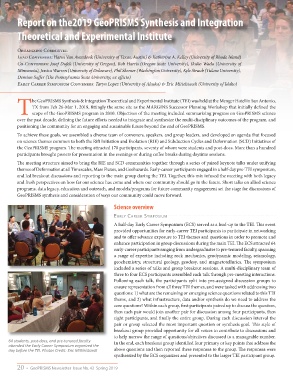
     64 students, post-docs, and pre-tenured faculty   In the end, each breakout group identified four primary or key points that address the
     attended the Early Career Symposium organized the
     day before the TEI. Photos Credit: Eric Mittlelstaedt  above questions and then reported these responses to the group. The responses were
                                                 synthesized by the ECS organizers and presented to the larger TEI participant group.

        20  •  GeoPRISMS Newsletter  Issue No. 42  Spring 2019

