


Page 35 - GeoPRISMS_Newsletter_Spring2019_42_Neat
P. 35
Slow slip

         NW    Ariel Bank                                                                                         SE
      0        Fault   Shelf break                                                                                    0
      1                            U1519  North Tuaheni Basin  Frontal accretionary wedge                 Tūranganui Knoll  1
      2                                                              U1518  Deformation                     U1526  VB  2
      3 4                                 Mesozoic & Paleogene              Front  Hikurangi Trough  U1520            3 4
     Depth km  5 6  Mesozoic & Paleogene  backstop or accreted                                                        5 6  Depth km
                                          Neogene rocks?
               deforming backstop

      8 7                                         1947 tsunami  Interplate thrust                                     7 8
                                                               in upper HKB
      9                                            earthquake                                                         9
     10                                                                                                               10
     11                                                                                               10 km    VE = 2  11
     12                                                                                                               12

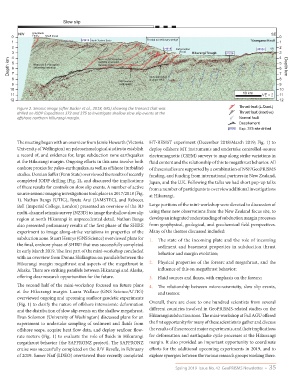
        Figure 2. Seismic image (after Barker et al., 2018, GRL) showing the transect that was       Thrust fault (L.Quat.)
        drilled on IODP Expeditions 372 and 375 to investigate shallow slow slip events at the       Thrust fault (inactive)
        offshore northern Hikurangi margin.                                                          Normal fault
                                                                                                     Decollement
                                                                                                U1519 Exp. 375 site drilled

        The meeting began with an overview from Jamie Howarth (Victoria  HT-RESIST experiment (December 2018/March 2019; Fig. 1) to
        University of Wellington) on paleoseismological studies to establish  deploy offshore MT instruments and undertake controlled-source
        a record of, and evidence for, large subduction zone earthquakes  electromagnetic (CSEM) surveys to map along strike variations in
        at the Hikurangi margin. Ongoing efforts in this area involve both  fluid content and the relationship of this to megathrust behavior. All
        onshore proxies for paleo-earthquakes, as well as offshore (turbidite)   of these studies are supported by a combination of NSF/GeoPRISMS
        studies. Demian Saffer (Penn State) overviewed the results of recently   funding, and funding from international partners in New Zealand,
        completed IODP drilling (Fig. 2), and discussed the implications   Japan, and the U.K. Following the talks we had short pop-up talks
        of these results for controls on slow slip events. A number of active   from a number of participants to overview additional investigations
        source seismic imaging investigations took place in 2017/2018 (Fig.   at Hikurangi.
        1). Nathan Bangs (UTIG), Ryuta Arai (JAMSTEC), and Rebecca
        Bell (Imperial College, London) presented an overview of the 3D   Large portions of the mini-workshop were devoted to discussion of
        multi-channel seismic survey (NZ3D) to image the shallow slow slip   using these new observations from the New Zealand focus site, to
        region at north Hikurangi in unprecedented detail. Nathan Bangs   develop an integrated understanding of subduction margin processes
        also presented preliminary results of the first phase of the SHIRE  from geophysical, geological, and geochemical field perspectives.
        experiment to image along-strike variations in properties of the  Many of the themes discussed included:
        subduction zone. Stuart Henrys (GNS Science) overviewed plans for   1.  The state of the incoming plate and the role of incoming
        the final, onshore phase of SHIRE that was successfully completed   sediment and basement properties in subduction thrust
        in early March 2019. The first part of the mini-workshop concluded   behavior and margin evolution;
        with an overview from Donna Shillington on parallels between the
        Hikurangi margin megathrust and aspects of the megathrust in   2.  Physical properties of the forearc and megathrust, and the
        Alaska. There are striking parallels between Hikurangi and Alaska,   influence of this on megathrust behavior;
        offering clear research opportunities for the future.   3.  Fluid sources and fluxes, with emphasis on the forearc;

        The second half of the mini-workshop focused on future plans   4.  The relationship between micro-seismicity, slow slip events,
        at the Hikurangi margin. Laura Wallace (GNS Science/UTIG)   and tremor.
        overviewed ongoing and upcoming seafloor geodetic experiments
        (Fig. 1) to clarify the nature of offshore interseismic deformation   Overall, there are close to one hundred scientists from several
        and the distribution of slow slip events on the shallow megathrust.   different countries involved in GeoPRISMS-related studies on the
        Evan Solomon (University of Washington) discussed plans for an   Hikurangi subduction zone. The mini-workshop at Fall AGU offered
        experiment to undertake sampling of sediment and fluids from   the first opportunity for many of these scientists to gather and discuss
        offshore seeps, acquire heat flow data, and deploy seafloor flow-  the results of these recent major experiments, and their implications   Photos by A. Férot
        rate meters (Fig. 1) to evaluate the role of fluids in Hikurangi  for deformation and earthquake cycle processes at the Hikurangi
        megathrust behavior (the SAFFRONZ project). The SAFFRONZ  margin. It also provided an important opportunity to coordinate
        cruise was successfully completed on the R/V Revelle, in February  efforts for the additional upcoming experiments in 2019, and to
        of 2019. Samer Naif (LDEO) overviewed their recently completed  explore synergies between the various research groups working there.

                                                                          Spring 2019  Issue No. 42  GeoPRISMS Newsletter  •  35

