


Page 34 - GeoPRISMS_Newsletter_Spring2019_42_Neat
P. 34
Investigating subduction processes at the

        Hikurangi margin, New Zealand


        Laura Wallace (GNS Science, New Zealand, Univ. Texas Institute for Geophysics), Dan Bassett (GNS Science, New Zealand),
        Samer Naif (Lamont-Doherty Earth Observatory, Columbia University), Patrick Fulton (Cornell University), Heather Savage
        (Lamont-Doherty Earth Observatory, Columbia University), Shuo Shuo Han (Univ. Texas Institute for Geophysics)


        A mini-workshop to discuss the latest research results from the  In particular, the strong along-strike variations in megathrust
        Hikurangi subduction zone (New Zealand), was held on Sunday  behavior and characteristics make it an ideal location to investigate
        afternoon before Fall AGU began in Washington, D.C. The mini-  the physical controls on subduction margin deformation and slip
        workshop had a record turnout, with 116 registrants from ten  behavior.
        different countries. A particular priority of this workshop was to   Data acquisition and analysis at the Hikurangi margin are ongoing
        get the broader community up to speed on the range of research   by scientists from New Zealand, the United States, Japan and Europe.
        activities and major experiments underway to better understand   Major experiments to investigate Hikurangi subduction processes
        the Hikurangi subduction zone, and to facilitate discussion to better   have taken place in the last year, including two Integrated Ocean
        integrate results between these projects.              Discovery Program (IODP) drilling expeditions to investigate slow
        Subduction of the Pacific Plate beneath New Zealand’s North Island  slip processes (Expeditions 372 & 375), and two seismic experiments
        occurs at the Hikurangi subduction margin. The Hikurangi margin  with the R/V Langseth and R/V Tangaroa to investigate controls
        offers an outstanding opportunity to address many of the key topics  on plate coupling and slow slip (Fig. 1). Additional NSF and New
        of the GeoPRISMS Subduction Cycles and Deformation initiative,  Zealand-funded experiments have taken place in the first few
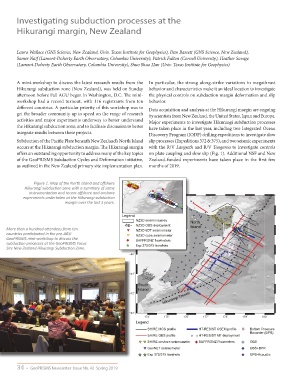
        as outlined in the New Zealand primary site implementation plan.  months of 2019.


               Figure 1. Map of the North Island and offshore
           Hikurangi subduction zone with a summary of some
             instrumentation and recent offshore and onshore   −37˚
           experiments undertaken at the Hikurangi subduction
                            margin over the last 3 years.
                                                       −38˚
                                                    Legend
                                                          NZ3D seismic survey    North
                                                          NZ3D OBS deployment    Island
    More than a hundred attendees from ten                NZ3D 6DT seismometer
    countries participated in the pre-AGU              −39˚  NZ3D cube seismometer
    GeoPRISMS mini-workshop to discuss the                SAFFRONZ flowmeters
    subduction processes at the GeoPRISMS Focus
    Site New Zealand Hikurangi Subduction Zone.           Exp 372/375 borehole
                                                       −40˚


                                                       −41˚

                                                           South
                                                           Island
                                                                     Hikurangi Trench
                                                       −42˚


                                                       −43˚
                                                             174˚     175˚    176˚    177˚    178˚    179˚    180˚
                                                          Legend
                                                               SHIRE MCS profile    HT-RESIST CSEM profile  Bottom Pressure
                                                                                                         Recorder (BPR)
                                                               SHIRE OBS profile    HT-RESIST MT deployment
                                                               SHIRE onshore seismometer  SAFFRONZ Flowmeters  OBS
                                                               GeoNET seismometer                        OBS+BPR
                                                               Exp 372/375 borehole                      GPS-Acoustic

        34  •  GeoPRISMS Newsletter  Issue No. 42  Spring 2019

