


Page 262 - Fanar
P. 262
i                                                                           Technical Information


            9.4. Toolholders balance


                 Definition of unbalance

                 Unbalance is a displacement of the center of gravity of the rotating mass from the axis of rotation.
                 The rotating mass includes: machine spindle, toolholder, intermediate components (collets), other
                 additional elements of toolholders (nuts) and tool The reason of unbalance is geometric asymmetry,
                 tolerance of, mounting errors, etc. Unbalance causes vibration of the setup, which reduce tool life
                 and decrease quality of machining.To limit to an acceptable level of unbalance minimize clearances
                 on the spindle and set suitable tools and toolholders. For most demanding applications it may be
                 necessary not only balancing the toolholders, but also the tools.


                 Balancing

                 Balancing is to reduce the unbalance by moving the center of rotating mass in the direction of the axis.
                 This is done by ensuring the proper geometry and adding additional weight or removing.
                 This target can only be achieved to some degree, as will always be residual unbalance.


                 Balance accuracy classes
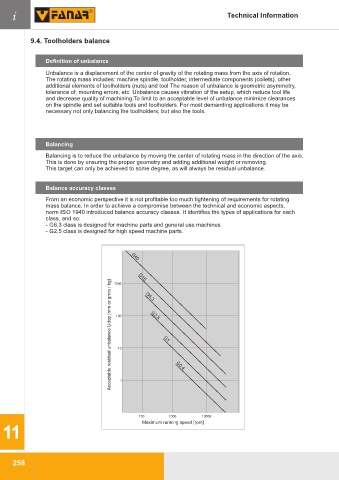
                 From an economic perspective it is not profitable too much tightening of requirements for rotating
                 mass balance. In order to achieve a compromise between the technical and economic aspects,
                 norm ISO 1940 introduced balance accuracy classes. It identifies the types of applications for each
                 class, and so:
                 - G6,3 class is designed for machine parts and general use machines
                 - G2,5 class is designed for high speed machine parts.


                                               G40


                                        Acceptable residual unbalance Udop [mm or gmm / kg]
                                         1000     G16 G6,3


                                          100         G2,5


                                          10               G1


                                           1                   G0,4


                                                  100       1000        10000
                                                   Maximum running speed [rpm]
  11


      258

