


Page 112 - analysis-and-interpretation-of-astronomical-sp
P. 112
Analysis and Interpretation of Astronomical Spectra                                       112

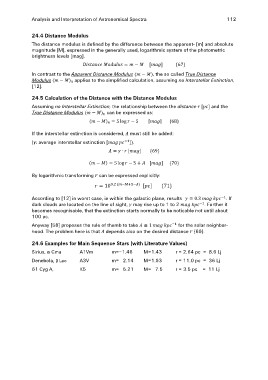
24.4 Distance Modulus
The distance modulus is defined by the difference between the apparent- [m] and absolute
magnitude [M], expressed in the generally used, logarithmic system of the photometric
brightness levels [mag].

In contrast to the Apparent Distance Modulus         , the so called True Distance

Modulus          applies to the simplified calculation, assuming no Interstellar Extinction,

[12].

24.5 Calculation of the Distance with the Distance Modulus

Assuming no Interstellar Extinction, the relationship between the distance  and the

True Distance Modulus              can be expressed as:

If the interstellar extinction is considered, must still be added:

( average interstellar extinction             .

By logarithmic transforming can be expressed explicitly:

According to [12] in worst case, ie within the galactic plane, results                    . If

dark clouds are located on the line of sight, may rise up to 1 to 2         . Further it

becomes recognisable, that the extinction starts normally to be noticable not until about
100 pc.

Anyway [58] proposes the rule of thumb to take                      for the solar neighbor-

hood. The problem here is that depends also on the desired distance {69}.

24.6 Examples for Main Sequence Stars (with Literature Values)

Sirius, α Cma    A1Vm              m=–1.46 M=1.43                   r = 2.64 pc = 8.6 Lj

Denebola, β Leo  A3V               m= 2.14 M=1.93                   r = 11.0 pc = 36 Lj

61 Cyg A,        K5                m= 5.21 M= 7.5                   r = 3.5 pc = 11 Lj

