


Page 108 - analysis-and-interpretation-of-astronomical-sp
P. 108
Analysis and Interpretation of Astronomical Spectra                                        108

23 Analysis of the Chemical Composition

23.1 Astrophysical Definition of Element Abundance

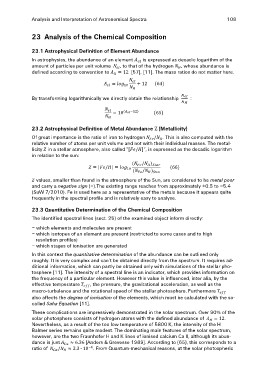
In astrophysics, the abundance of an element is expressed as decadic logarithm of the

amount of particles per unit volume , to that of the hydrogen , whose abundance is

defined according to convention to           [57], [11]. The mass ratios do not matter here.

By transforming logarithmically we directly obtain the relationship :

23.2 Astrophysical Definition of Metal Abundance Z (Metallicity)

Of great importance is the ratio of iron to hydrogen  . This is also computed with the

relative number of atoms per unit volume and not with their individual masses. The metal-
licity in a stellar atmosphere, also called           , is expressed as the decadic logarithm

in relation to the sun:

  values, smaller than found in the atmosphere of the Sun, are considered to be metal poor
and carry a negative sign (–).The existing range reaches from approximately +0.5 to –5.4
(SuW 7/2010). Fe is used here as a representative of the metals because it appears quite
frequently in the spectral profile and is relatively easy to analyse.

23.3 Quantitative Determination of the Chemical Composition
The identified spectral lines (sect. 25) of the examined object inform directly:

– which elements and molecules are present
– which isotopes of an element are present (restricted to some cases and to high

  resolution profiles)
– which stages of ionisation are generated

In this context the quantitative determination of the abundance can be outlined only
roughly. It is very complex and can’t be obtained directly from the spectrum. It requires ad-
ditional information, which can partly be obtained only with simulations of the stellar pho-
tosphere [11]. The intensity of a spectral line is an indicator, which provides information on
the frequency of a particular element. However this value is influenced, inter alia, by the
effective temperature , the pressure, the gravitational acceleration, as well as the

macro-turbulence and the rotational speed of the stellar photosphere. Furthermore

also affects the degree of ionisation of the elements, which must be calculated with the so-
called Saha Equation [11].

These complications are impressively demonstrated in the solar spectrum. Over 90% of the
solar photosphere consists of hydrogen atoms with the defined abundance of              .

Nevertheless, as a result of the too low temperature of 5800 K, the intensity of the H
Balmer series remains quite modest. The dominating main features of the solar spectrum,
however, are the two Fraunhofer H and K lines of ionised calcium Ca II, although its abun-
dance is just            [Anders & Grevesse 1989]. According to {65}, this corresponds to a

ratio of                 . From Quantum-mechanical reasons, at the solar photospheric

