


Page 88 - analysis-and-interpretation-of-astronomical-sp
P. 88
Analysis and Interpretation of Astronomical Spectra                                          88

– Both orbital ellipse:
   – must be in the same plane
   – have different axis lengths, inversely proportional to their stellar masses

– must be similar to each other, i.e. have the same eccentricity

– The more massive star          always runs on the smaller elliptical orbit and with the lower

velocity around the barycenter.

– The barycenter lies always in one of the two focal points

– und always run synchronously:

– During the entire orbit the connecting line between and runs permanently
    through the barycenter

– and always reach the Apastron as well as the Periastron at the same time.

19.2 Effects of the Binary Orbit on the Spectrum

Due to the radial velocities the Doppler shift causes striking effects in the spectrum. The
above assumed perspective special case for the orbit orientation would maximize these
phenomena for a terrestrial observer (see below phase D). Generally, two different cases
can be distinguished [180].
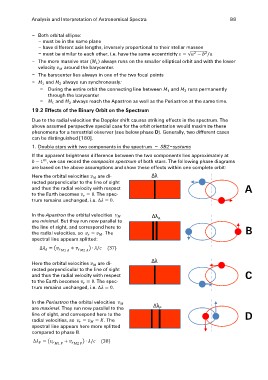
1. Double stars with two components in the spectrum – SB2–systems

If the apparent brightness difference between the two components lies approximately at
         , we can record the composite spectrum of both stars. The following phase diagrams

are based on the above assumptions and show these effects within one complete orbit:

Here the orbital velocities are di-                  ∆λ

rected perpendicular to the line of sight                                                        A
and thus the radial velocity with respect
to the Earth becomes          The spec-

trum remains unchanged, i.e.

In the Apastron the orbital velocities               ∆λA

are minimal. But they run now parallel to                                                        B

the line of sight, and correspond here to
the radial velocities, so        . The

spectral line appears splitted:

Here the orbital velocities are di-                  ∆λ
                                                     ∆λP
rected perpendicular to the line of sight                                                        C
and thus the radial velocity with respect                                                        D
to the Earth becomes          The spec-

trum remains unchanged, i.e.

In the Periastron the orbital velocities

are maximal. They run now parallel to the

line of sight, and correspond here to the
radial velocities, so            . The

spectral line appears here more splitted
compared to phase B.

