


Page 115 - Super Earth Encyclopedia
P. 115
DRIFTING ICY


                                                                  ISLANDS


                                                                    ICEBERGS


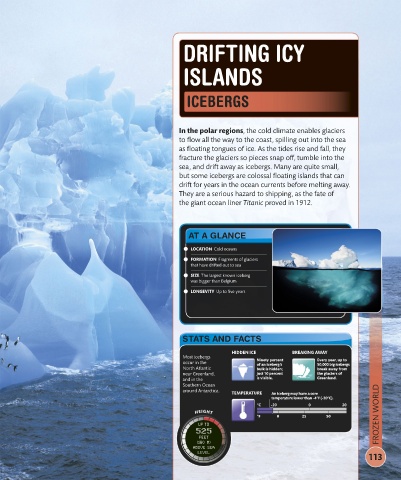
                                                                 In the polar regions, the cold climate enables glaciers
                                                                 to flow all the way to the coast, spilling out into the sea
                                                                 as floating tongues of ice. As the tides rise and fall, they
                                                                 fracture the glaciers so pieces snap off, tumble into the
                                                                 sea, and drift away as icebergs. Many are quite small,
                                                                 but some icebergs are colossal floating islands that can
                                                                 drift for years in the ocean currents before melting away.
                                                                 They are a serious hazard to shipping, as the fate of
                                                                 the giant ocean liner Titanic proved in 1912.


                                                                    AT A GLANCE

                                                                  •  LOCATION  Cold oceans
                                                                  •  FORMATION  Fragments of glaciers
                                                                     that have drifted out to sea
                                                                  •  SIZE  The largest known iceberg
                                                                     was bigger than Belgium
                                                                  •  LONGEVITY  Up to five years


                                                                  STATS AND FACTS


                                                                                    HIDDEN ICE           BREAKING AWAY
                                                                  Most icebergs
                                                                  occur in the              Ninety percent        Every year, up to
                                                                                                                  50,000 big icebergs
                                                                                            of an iceberg’s
                                                                  North Atlantic            bulk is hidden;       break away from
                                                                  near Greenland,           just 10 percent       the glaciers of
                                                                  and in the                is visible.           Greenland.
                                                                  Southern Ocean
                                                                  around Antarctica.
                                                                                    TEMPERATURE   An iceberg may have a core
                                                                                                  temperature lower than -4°F (-20°C).
                                                                                             °C   -20          0           20
                                                                       HEIGHT
                                                                                             °F     0        25      50                 FROZEN WORLD
                                                                        UP TO
                                                                       525
                                                                        FEET
                                                                       (160 M)
                                                                      ABOVE SEA
                                                                       LEVEL
                                                                                                                                    113


   US_112-113_Icebergs.indd   113                                                                                                    20/03/17   4:48 pm

