


Page 148 - Super Earth Encyclopedia
P. 148
SHOCK AND AWE


                     THUNDERSTORM


                  Moisture evaporating from warm ground can build
                  gigantic storm clouds. Moist air rising through each
                  cloud generates powerful updrafts that toss water
                  droplets and ice crystals up and down. This produces
                  static electricity in the cloud, charging it like a giant
                  battery. Eventually, the cloud reaches an incredibly
                  high voltage that starts breaking down the electrical
                  resistance of the air, and faint branched leaders of
                  lightning move toward the ground. When one makes
                  contact, the main discharge shoots back up the leader
                  with a much brighter flash—and a loud crack of thunder.


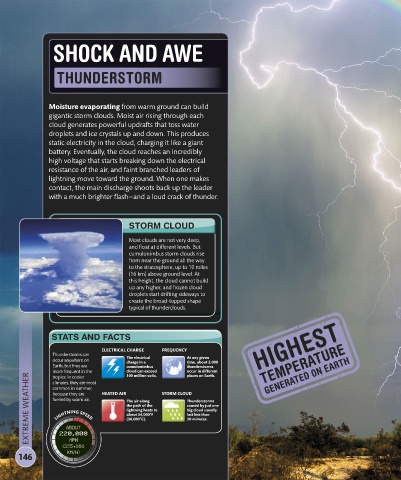
                                               STORM CLOUD


                                               Most clouds are not very deep,
                                               and float at different levels. But
                                               cumulonimbus storm clouds rise
                                               from near the ground all the way
                                               to the stratosphere, up to 10 miles
                                               (16 km) above ground level. At
                                               this height, the cloud cannot build
                                               up any higher, and frozen cloud
                                               droplets start drifting sideways to
                                               create the broad-topped shape
                                               typical of thunderclouds.


                   STATS AND FACTS

                                     ELECTRICAL CHARGE     FREQUENCY                         HIGHEST
                    Thunderstorms can
                    occur anywhere on         The electrical        At any given              TEMPERATURE
                                              charge in a
                                                                    time, about 2,000
                    Earth, but they are       cumulonimbus          thunderstorms
                    more frequent in the      cloud can exceed      occur in different          GENERATED ON EARTH
           EXTREME WEATHER  because they are   HEATED AIR The air along    STORM CLOUD
                                              100 million volts.
                                                                    places on Earth.
                    tropics. In cooler
                    climates, they are most
                    common in summer,
                    fuelled by warm air.
                                                                    Thunderstorms
                                              the path of the
                                                                    caused by just one
                                              lightning heats to
                                                                    big cloud usually
                                                                    last less than
                                              about 54,000°F
                     LIGHTNING SPEED
                                                                    30 minutes.
                                              (30,000°C).
                         ABOUT
                      220,000
                          MPH
                       (355,000
        146              KM/H)


   US_146-147_Thunderstorm.indd   146                                                                                               01/03/17   12:26 pm

