


Page 88 - Super Earth Encyclopedia
P. 88
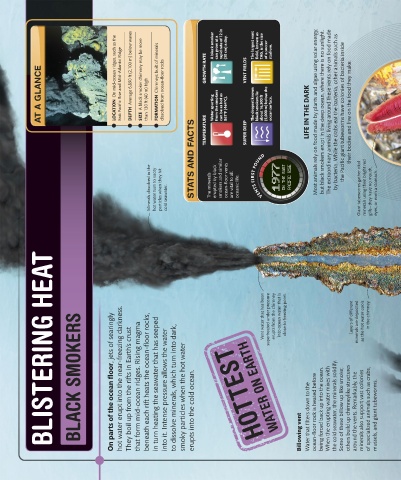
AT A GLANCE               LOCATION  On mid-ocean ridges, such as the  East Pacific Rise and Mid-Atlantic Ridge DEPTH  Average 6,890 ft (2,100 m) below waves SIZE  A black smoker chimney may be more    than 130 ft (40 m) high FORMATION  Chimneys built of minerals  dissolved from ocean-floor rocks  GROWTH RATE  A black smoker  Water spurting   can grow at a   from the smokers   rapid rate of 12 in   can be as hot as   (30 cm) a day.  867ºF (464ºC).  VENT FIELDS  The largest vent  The deepest known   field, known as  black smokers lie   TAG, is the


                                           •     •   •    •               TEMPERATURE    SUPER DEEP            LIFE IN THE DARK Most animals rely on food made by plants and algae using solar energy,  but black smokers erupt in the deep ocean, where there is no sunlight.  The extraordinary animals living around these vents rely on food made   by bacteria. While the crabs eat the bacteria, other animals such as   the Pacific giant tubeworms have colonies of bacteria inside   their bodies and live on the food they make.


                                                       Minerals dissolved in the   hot water turn to sooty   particles when they hit   cold seawater.  STATS AND FACTS  The minerals   erupted by black   smokers and similar   ocean-floor vents   are vital to all   oceanic life.  VENTS FIRST FOUND  1977  ON THE EAST   PACIFIC RISE  Giant tubeworms gather vital  minerals using their bright red  gills—they have no mouth,    eyes, or even a stomach.


                    BLISTERING HEAT


                                                                                               Vent water that has been  superheated under pressure   erupts from the chimney   into ocean water that is   close to freezing point.  Layers of different   minerals are deposited     as the hot water cools     in the chimney.

                                            hot water erupt into the near-freezing darkness.
                                         On parts of the ocean floor, jets of searingly
                                                      beneath each rift heats the ocean-floor rocks,
                              BLACK SMOKERS
                                                         in turn heating the seawater that has seeped
                                                   that form mid-ocean ridges. Rising magma
                                                                to dissolve minerals, which turn into dark,
                                                They boil up from the rifts in Earth’s crust
                                                            into it. Intense pressure allows the water
                                                                   smoky particles when the hot water


                                                                      erupts into the cold ocean.  HOTTEST   WATER ON EARTH  Billowing vent Water that filters down to the   ocean-floor rock is heated before  being forced back up into the ocean.  When the erupting water mixes with  the cold seawater, the minerals solidify.  Some of these billow up like smoke;  others build up chimneylike structures  around the vents. Remarkably, the  minerals also support vast colonies   of specialized animals such as crabs,  mussels, and giant tubeworms.


   US_086-087_Black_Smokers_a_w.indd   86                                                                                            02/03/17   4:55 pm

