


Page 49 - DK Findout! Forest
P. 49
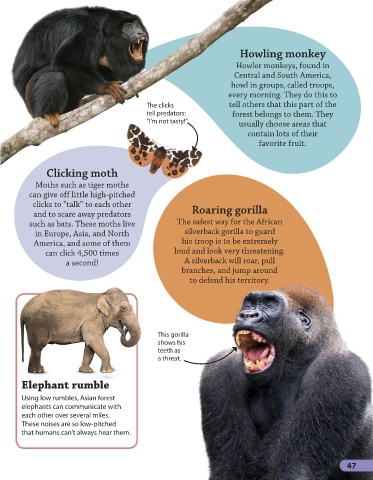
Howling monkey
                                                                   Howler monkeys, found in
                                                                  Central and South America,
                                                                 howl in groups, called troops,
                                                                 every morning. They do this to
                                          The clicks             tell others that this part of the
                                          tell predators:         forest belongs to them. They
                                          “I’m not tasty!”         usually choose areas that
                                                                      contain lots of their
                                                                         favorite fruit.


              Clicking moth
           Moths such as tiger moths
         can give off little high-pitched
          clicks to “talk” to each other              Roaring gorilla
          and to scare away predators
         such as bats. These moths live           The safest way for the African
           in Europe, Asia, and North               silverback gorilla to guard
          America, and some of them                 his troop is to be extremely
              can click 4,500 times               loud and look very threatening.
                   a second!                        A silverback will roar, pull
                                                    branches, and jump around
                                                      to defend his territory.


                                             This gorilla
                                             shows his
                                             teeth as
                                             a threat.


       Elephant rumble
       Using low rumbles, Asian forest
       elephants can communicate with
       each other over several miles.
       These noises are so low-pitched
       that humans can’t always hear them.


                                                                                                 47
                                                                                         ૧ٮሧჷ܄ᇙݼğᆩ࢝ሧ࿊
                                                                                         čXXX [IJKJBP[JYVBO WJQĎ


   US_046_047_Sounds_of_the_forest.indd   47                                                  12/01/2017   14:50

