


Page 30 - DINOSOUR ATLAS
P. 30
north america
         Petrified Forest                                                                            GU        N   1BJOUFE %FTFSU
                                                                                                     1JMPU 3PDL

                                                                                                                             .AVAJO
                                                                                                     #HINDE 0OINT
         In northeastern arIzona there is a remarkable site from the Late Triassic.                               1VFSDP 3JWFS
         About 220 million years ago, a great forest of conifer trees grew somewhere
         in this area. In times of flood many were uprooted, carried along by the               (OLBROOK
         water, and piled up in heaps on the land, where they were slowly
         fossilized. Today, these ancient tree trunks lie scattered across                                       0ETRIFIED &OREST
                                                                                                                 .ATIONAL 0ARK
         the landscape, in an area known as the Petrified Forest National
         Park. There are also fossils of the world’s first dinosaurs, such
         as Chindesaurus, together with amphibians and large-tusked
         plant-eaters called dicynodonts.                                                        u site location
                                                                                                 Petrified Forest National Park was established in
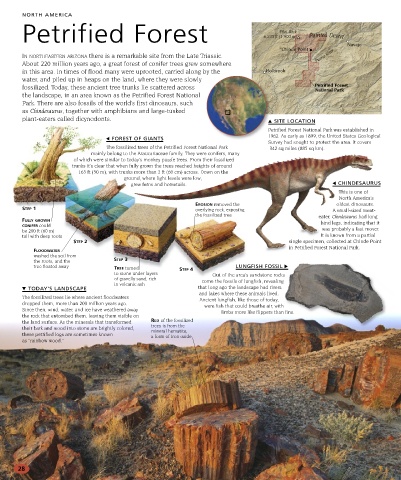
                                       , forest of giants                                        1962. As early as 1899, the United States Geological
                                                                                                 Survey had sought to protect the area. It covers
                                       The fossilized trees of the Petrified Forest National Park    342 sq miles (885 sq km).
                                 mainly belong to the Araucariaceae family. They were conifers, many
                           of which were similar to today’s monkey puzzle trees. From their fossilized
                           trunks it’s clear that when fully grown the trees reached heights of around
                             165 ft (50 m), with trunks more than 2 ft (60 cm) across. Down on the
                                             ground, where light levels were low,
                                                grew ferns and horsetails.                                              , chindesaurus
                                                                                                                          This is one of
                                                                                                                          North America’s
                                                                       eRosion removed the                               oldest dinosaurs.
         step 1                                                        overlying rock, exposing                         A small-sized meat-
                                                                       the fossilized tree                         eater, Chindesaurus had long
         Fully gRown                                                                                               hind legs, indicating that it
         coniFeR could
         be 200 ft (60 m)                                                                                           was probably a fast mover.
         tall with deep roots                                                                                      It is known from a partial
                           step 2                                                                       single specimen, collected at Chinde Point
                                                                                                        in Petrified Forest National Park.
             FloodwateR
             washed the soil from
             the roots, and the           step 3
             tree floated away            tRee turned            step 4              lungfish fossil .
                                          to stone under layers              Out of the area’s sandstone rocks
                                          of gravelly sand, rich         come the fossils of lungfish, revealing
                                          in volcanic ash
         d today’s landscape                                            that long ago the landscape had rivers
                                                                        and lakes where these animals lived.
         The fossilized trees lie where ancient floodwaters             Ancient lungfish, like those of today,
         dropped them, more than 200 million years ago.                   were fish that could breathe air, with
         Since then, wind, water, and ice have weathered away                   limbs more like flippers than fins.
         the rock that entombed them, leaving them visible on
         the land surface. As the minerals that transformed   Red of the fossilized
         their bark and wood into stone are brightly colored,   trees is from the
         these petrified logs are sometimes known      mineral hematite,
                                                       a form of iron oxide
         as “rainbow wood.”


       28

