


Page 28 - DINOSOUR ATLAS
P. 28
north america
         Provincial Park


                                                                                                        7ARDLOW #FSSZ $SFFL

         One Of the wOrld’s great dinosaur locations is Dinosaur Provincial Park,                                         3FE %FFS 3JWFS
                                                                                              3FE %FFS 3JWFS
         along the Red Deer River in southern Alberta, Canada. In 1910, after a
         farmer found dinosaur bones on his land, paleontologists began to
         study the area. Almost 40 different species of Late Cretaceous                                                    )DDESLEIGH
         dinosaur have been found here, including Corythosaurus,                                    0ATRICIA     $INOSAUR
                                                                                                                 0ROVINCIAL 0ARK
         Centrosaurus, Pachycephalosaurus, and Euoplocephalus. They lived
         about 75 million years ago, when the area was marshy land
         at the mouth of a river and the climate was warm. Today,
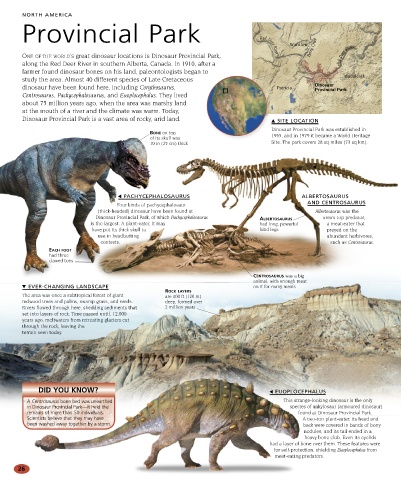
         Dinosaur Provincial Park is a vast area of rocky, arid land.                             u site location
                                                                                                  Dinosaur Provincial Park was established in
                                                      Bone on top                                 1955, and in 1979 it became a World Heritage
                                                      of its skull was
                                                      10 in (25 cm) thick                         Site. The park covers 28 sq miles (73 sq km).


                                                                                                                 ,


                                           , pachycephalosaurus                                              albertosaurus
                                           Four kinds of pachycephalosaur                                      and centrosaurus
                                    (thick-headed) dinosaur have been found at                                   Albertosaurus was the
                                   Dinosaur Provincial Park, of which Pachycephalosaurus      alBeRtosauRus         area’s top predator,
                                 is the largest. A plant-eater, it may                        had long, powerful      a meat-eater that
                                  have put its thick skull to                                 hind legs               preyed on the
                                    use in headbutting                                                                abundant herbivores,
                                     contests.                                                                         such as Centrosaurus.
                   each foot
                   had three
                   clawed toes


                                                                                           centRosauRus was a big
                                                                                           animal, with enough meat
         d ever-changing landscape                                                         on it for many meals
                                                            Rock layeRs
         The area was once a subtropical forest of giant    are 400 ft (120 m)
         redwood trees and palms, swamp grass, and reeds.   deep, formed over
         Rivers flowed through here, shedding sediments that   2 million years
         set into layers of rock. Time passed until, 12,000
         years ago, meltwaters from retreating glaciers cut
         through the rock, leaving the
         terrain seen today.


               did you know?                                                                     , euoplocephalus
         . A Centrosaurus bone bed was unearthed                                                      This strange-looking dinosaur is the only
           in Dinosaur Provincial Park—it held the                                                      species of ankylosaur (armoured dinosaur)
           remains of more than 50 individuals.                                                            found at Dinosaur Provincial Park.
           Scientists believe that they may have                                                             A two-ton plant-eater, its head and
           been washed away together by a storm.                                                             back were covered in bands of bony
                                                                                                             nodules, and its tail ended in a
                                                                                                             heavy bone club. Even its eyelids
                                                                                                 had a layer of bone over them. These features were
                                                                                                   for self-protection, shielding Euoplocephalus from
                                                                                                   meat-eating predators.
       26

