


Page 74 - DINOSOUR ATLAS
P. 74
AustrAliA And AntArcticA
         Dinosaur Cove                                                                                V  Lake Corangamite  O  R  I  Geelong

                                                                                                          I
                                                                                                                 T
                                                                                                                                  A
                                                                                                             C
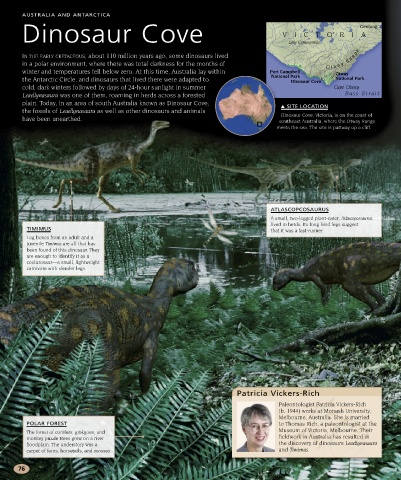
         In the early cretaceous, about 110 million years ago, some dinosaurs lived                                  O t w a y   R a n g e
         in a polar environment, where there was total darkness for the months of
         winter and temperatures fell below zero. At this time, Australia lay within             Port Campbell           Otway
         the Antarctic Circle, and dinosaurs that lived there were adapted to                     National Park          National Park
                                                                                                         Dinosaur Cove
         cold, dark winters followed by days of 24-hour sunlight in summer.                                             Cape Otway
         Leaellynasaura was one of them, roaming in herds across a forested                                                 B a s s   S t r a i t
         plain. Today, in an area of south Australia known as Dinosaur Cove,                         u site locAtion
         the fossils of Leaellynasaura as well as other dinosaurs and animals
                                                                                                     Dinosaur Cove, Victoria, is on the coast of
         have been unearthed.                                                                        southeast Australia, where the Otway Range
                                                                                                    meets the sea. The site is partway up a cliff.


                                                                                                 AtlAscoPcosAurus
                                                                                                 A small, two-legged plant-eater, Atlascopcosaurus
                                                                                                 lived in herds. Its long hind legs suggest
           tiMiMus                                                                               that it was a fast-runner.
           Leg bones from an adult and a
           juvenile Timimus are all that has
           been found of this dinosaur. They
           are enough to identify it as a
           coelurosaur—a small, lightweight
           carnivore with slender legs.


                                                                                     Patricia Vickers-rich

                                                                                                    Paleontologist Patricia Vickers-Rich
                                                                                                    (b. 1944) works at Monash University,
                                                                                                    Melbourne, Australia. She is married
          PolAr forest                                                                              to Thomas Rich, a paleontologist at the
          The forest of conifers, ginkgoes, and                                                     Museum of Victoria, Melbourne. Their
          monkey puzzle trees grew on a river                                                       fieldwork in Australia has resulted in
          floodplain. The understory was a                                                          the discovery of dinosaurs Leaellynasaura
          carpet of ferns, horsetails, and mosses.                                                  and Timimus.

       76

