


Page 79 - DINOSOUR ATLAS
P. 79
australia and antarctica
         Islands of Antarctica


         Dinosaur fossils have been DiscovereD on two of Antarctica’s islands.
         The bone fragments that have been collected from James Ross Island
         and Vega Island belong to the Late Cretaceous world. Imagine a woodland                     Bransfield Strait
         environment where a meat-eating dinosaur stalked its prey (or scavenged
         on the body of an already dead animal), scaring a herd of timid,
         ostrichlike hypsilophodonts that ran for their lives past a slow-moving                                       Vega Island
         ankylosaur. This was the Antarctica of about 80 million years ago.                                          James Ross Island
         In recent years, teams of paleontologists have begun to reveal this                        Antarctic Peninsula
         lost world. In areas not covered by snow and ice, they scour the                                             SOUTHERN OCEAN
         rocky terrain for evidence of dinosaurs.
                                                                                                           Weddell
                                                                                                             Sea
         d icY island landscaPE
                                                                                                 u sitE location
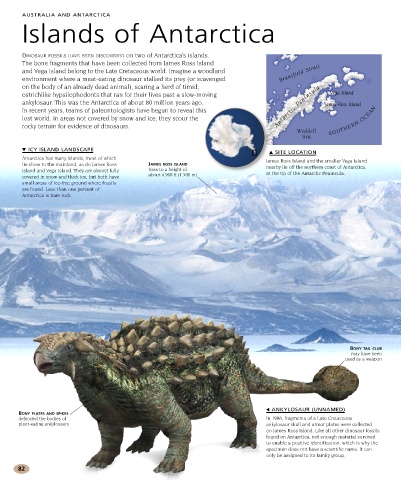
         Antarctica has many islands, most of which                                             James Ross Island and the smaller Vega Island
         lie close to the mainland, as do James Ross   James ross island                        nearby lie off the northern coast of Antarctica,
         Island and Vega Island. They are almost fully   rises to a height of                   at the tip of the Antarctic Peninsula.
         covered in snow and thick ice, but both have   about 4,900 ft (1,500 m)
         small areas of ice-free ground where fossils
         are found. Less than one percent of
         Antarctica is bare rock.


                                                                                                                              Bony tail cluB
                                                                                                                              may have been
                                                                                                                            used as a weapon


                                                                                                , ankYlosaur (unnamEd)
        Bony plates and spikes
        defended the bodies of                                                                  In 1986, fragments of a Late Cretaceous
        plant-eating ankylosaurs                                                                ankylosaur skull and armor plates were collected
                                                                                                on James Ross Island. Like all other dinosaur fossils
                                                                                                found on Antarctica, not enough material survived
                                                                                                to enable a positive identification, which is why the
                                                                                                specimen does not have a scientific name. It can
                                                                                                only be assigned to its family group.

       82

