


Page 80 - DINOSOUR ATLAS
P. 80
islands of antarctica
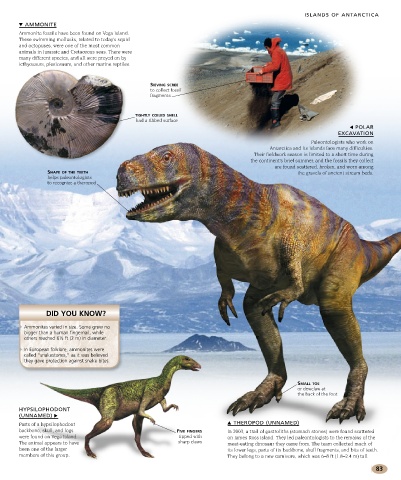
        d ammonitE
        Ammonite fossils have been found on Vega Island.
        These swimming mollusks, related to today’s squid
        and octopuses, were one of the most common
        animals in Jurassic and Cretaceous seas. There were
        many different species, and all were preyed on by
        icthyosaurs, plesiosaurs, and other marine reptiles.


                                                       sieving scree
                                                       to collect fossil
                                                       fragments


                                                 tightly coiled shell
                                                 had a ribbed surface
                                                                                                                              , Polar
                                                                                                                         EXcavation
                                                                                                                Paleontologists who work on
                                                                                                 Antarctica and its islands face many difficulties.
                                                                                            Their fieldwork season is limited to a short time during
                                                                                          the continent’s brief summer, and the fossils they collect
                                                                                                   are found scattered, broken, and worn among
                  shape oF the teeth                                                                       the gravels of ancient stream beds.
                  helps paleontologists
                  to recognize a theropod


                  did you know?

        . Ammonites varied in size. Some grew no
          bigger than a human fingernail, while
          others reached 6½ ft (2 m) in diameter.

        . In European folklore, ammonites were
          called “snakestones,” as it was believed
          they gave protection against snake bites.


                                                                                                           small toe
                                                                                                           or dewclaw at
                                                                                                           the back of the foot

        hYPsiloPhodont
        (unnamEd) .
        Parts of a hypsilophodont                                                 u thEroPod (unnamEd)
        backbone, skull, and legs                               Five Fingers      In 2003, a trail of gastroliths (stomach stones) were found scattered
        were found on Vega Island.                               tipped with      on James Ross Island. They led paleontologists to the remains of the
        The animal appears to have                               sharp claws      meat-eating dinosaur they came from. The team collected much of
        been one of the larger                                                    its lower legs, parts of its backbone, skull fragments, and bits of teeth.
        members of this group.                                                    They belong to a new carnivore, which was 6–8 ft (1.8–2.4 m) tall.

                                                                                                                                       83

