


Page 13 - ABATE of FL, Inc
P. 13
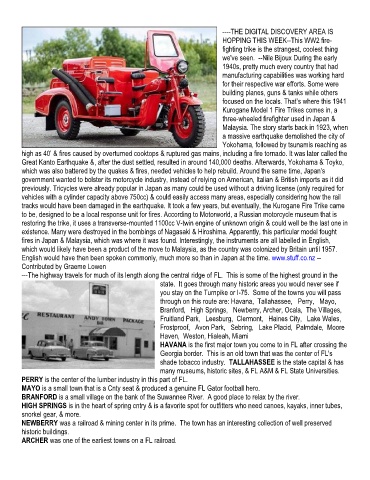
----THE DIGITAL DISCOVERY AREA IS
                                                                           HOPPING THIS WEEK--This WW2 fire-
                                                                           fighting trike is the strangest, coolest thing
                                                                           we've seen.  --Nile Bijoux During the early
                                                                           1940s, pretty much every country that had
                                                                           manufacturing capabilities was working hard
                                                                           for their respective war efforts. Some were
                                                                           building planes, guns & tanks while others
                                                                           focused on the locals. That’s where this 1941
                                                                           Kurogane Model 1 Fire Trikes comes in, a
                                                                           three-wheeled firefighter used in Japan &
                                                                           Malaysia. The story starts back in 1923, when
                                                                           a massive earthquake demolished the city of
                                                                           Yokohama, followed by tsunamis reaching as
        high as 40’ & fires caused by overturned cooktops & ruptured gas mains, including a fire tornado. It was later called the
        Great Kanto Earthquake &, after the dust settled, resulted in around 140,000 deaths. Afterwards, Yokohama & Toyko,
        which was also battered by the quakes & fires, needed vehicles to help rebuild. Around the same time, Japan’s
        government wanted to bolster its motorcycle industry, instead of relying on American, Italian & British imports as it did
        previously. Tricycles were already popular in Japan as many could be used without a driving license (only required for
        vehicles with a cylinder capacity above 750cc) & could easily access many areas, especially considering how the rail
        tracks would have been damaged in the earthquake. It took a few years, but eventually, the Kurogane Fire Trike came
        to be, designed to be a local response unit for fires. According to Motorworld, a Russian motorcycle museum that is
        restoring the trike, it uses a transverse-mounted 1100cc V-twin engine of unknown origin & could well be the last one in
        existence. Many were destroyed in the bombings of Nagasaki & Hiroshima. Apparently, this particular model fought
        fires in Japan & Malaysia, which was where it was found. Interestingly, the instruments are all labelled in English,
        which would likely have been a product of the move to Malaysia, as the country was colonized by Britain until 1957.
        English would have then been spoken commonly, much more so than in Japan at the time. www.stuff.co.nz --
        Contributed by Graeme Lowen
        ---The highway travels for much of its length along the central ridge of FL.  This is some of the highest ground in the
                                                      state.  It goes through many historic areas you would never see if
                                                      you stay on the Turnpike or I-75.  Some of the towns you will pass
                                                      through on this route are: Havana,  Tallahassee,   Perry,   Mayo,
                                                      Branford,   High Springs,   Newberry, Archer, Ocala,  The Villages,
                                                      Fruitland Park,   Leesburg,  Clermont,   Haines City,   Lake Wales,
                                                      Frostproof,   Avon Park,   Sebring,   Lake Placid,  Palmdale,  Moore
                                                      Haven,  Weston, Hialeah, Miami
                                                      HAVANA is the first major town you come to in FL after crossing the
                                                      Georgia border.  This is an old town that was the center of FL's
                                                      shade tobacco industry.  TALLAHASSEE is the state capital & has
                                                      many museums, historic sites, & FL A&M & FL State Universities.
        PERRY is the center of the lumber industry in this part of FL.
        MAYO is a small town that is a Cnty seat & produced a genuine FL Gator football hero.
        BRANFORD is a small village on the bank of the Suwannee River.  A good place to relax by the river.
        HIGH SPRINGS is in the heart of spring cntry & is a favorite spot for outfitters who need canoes, kayaks, inner tubes,
        snorkel gear, & more.
        NEWBERRY was a railroad & mining center in its prime.  The town has an interesting collection of well preserved
        historic buildings.
        ARCHER was one of the earliest towns on a FL railroad.

